
Ch. 7 - Logarithmic, Exponential Functions, and Hyperbolic Functions
Briggs - Calculus: Early Transcendentals 3rd Edition
Briggs3rd EditionCalculus: Early TranscendentalsISBN: 9780136847243당신이 사용하는 게 아니라요?교과서 변경
7장, 문제 7.1.75

Bounds on e Use a left Riemann sum with at least n = 2 subintervals of equal length to approximate ln 2 = ∫[1 to 2] (dt/t) and show that ln 2 < 1. Use a right Riemann sum with n = 7 subintervals of equal length to approximate ln 3 = ∫[1 to 3] (dt/t) and show that ln 3 > 1.

검증된 단계별 안내
1
First, recall that the natural logarithm function can be expressed as an integral: \(\ln b = \int_1^b \frac{1}{t} \, dt\) for \(b > 0\).
To approximate \(\ln 2 = \int_1^2 \frac{1}{t} \, dt\) using a left Riemann sum with \(n=2\) subintervals, divide the interval \([1,2]\) into 2 equal parts. Each subinterval has length \(\Delta t = \frac{2-1}{2} = 0.5\).
Identify the left endpoints of the subintervals: \(t_0 = 1\) and \(t_1 = 1.5\). Then, the left Riemann sum approximation is \(L_2 = \Delta t \left( \frac{1}{t_0} + \frac{1}{t_1} \right)\).
Since \(\frac{1}{t}\) is a decreasing function on \([1,2]\), the left Riemann sum overestimates the integral. Therefore, \(L_2 > \int_1^2 \frac{1}{t} \, dt = \ln 2\). Use this to show that \(\ln 2 < 1\) by evaluating the sum (without calculating the exact value here).
Next, to approximate \(\ln 3 = \int_1^3 \frac{1}{t} \, dt\) using a right Riemann sum with \(n=7\) subintervals, divide \([1,3]\) into 7 equal parts with \(\Delta t = \frac{3-1}{7} = \frac{2}{7}\). The right endpoints are \(t_i = 1 + i \Delta t\) for \(i=1\) to \(7\). The right Riemann sum is \(R_7 = \Delta t \sum_{i=1}^7 \frac{1}{t_i}\).
Since \(\frac{1}{t}\) is decreasing, the right Riemann sum underestimates the integral, so \(R_7 < \ln 3\). However, the problem asks to show \(\ln 3 > 1\), so you can compare \(R_7\) to 1 and use the inequality to conclude \(\ln 3 > 1\).

비슷한 문제에 대한 검증된 영상 답변:

이 영상 해법은 위 문제에 도움이 된다고 튜터들이 추천한 것입니다.
영상 길이:
3m
도움이 되었나요?

주요 개념

질문에 올바르게 답하기 위해 반드시 이해해야 하는 핵심 개념들은 다음과 같습니다.

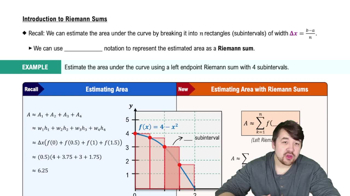
Riemann Sums

Riemann sums approximate the value of a definite integral by dividing the integration interval into subintervals and summing the areas of rectangles. The height of each rectangle is determined by the function value at specific points (left, right, or midpoint) within each subinterval. Increasing the number of subintervals generally improves the approximation.
추천 영상:
가이드 코스
06:11
Introduction to Riemann Sums

Properties of the Natural Logarithm as an Integral

The natural logarithm function ln(x) can be expressed as an integral: ln(x) = ∫₁ˣ (1/t) dt. This integral representation allows us to approximate ln(x) by evaluating the integral numerically, such as with Riemann sums, linking logarithmic values to areas under the curve y = 1/t.
추천 영상:
05:36
Change of Base Property

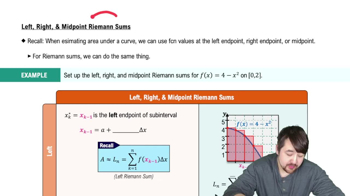
Inequalities from Left and Right Riemann Sums

For a decreasing function, left Riemann sums overestimate the integral, while right Riemann sums underestimate it; for an increasing function, the opposite holds. Since 1/t is decreasing on [1, ∞), left sums provide upper bounds and right sums provide lower bounds, enabling inequalities like ln 2 < 1 and ln 3 > 1.
추천 영상:
가이드 코스
07:39
Left, Right, & Midpoint Riemann Sums