
Ch. 7 - Logarithmic, Exponential Functions, and Hyperbolic Functions
Briggs - Calculus: Early Transcendentals 3rd Edition
Briggs3rd EditionCalculus: Early TranscendentalsISBN: 9780136847243당신이 사용하는 게 아니라요?교과서 변경
7장, 문제 7.2.45d

Chemotherapy In an experimental study at Dartmouth College, mice with tumors were treated with the chemotherapeutic drug Cisplatin. Before treatment, the tumors consisted entirely of clonogenic cells that divide rapidly, causing the tumors to double in size every 2.9 days. Immediately after treatment, 99% of the cells in the tumor became quiescent cells which do not divide and lose 50% of their volume every 5.7 days. For a particular mouse, assume the tumor size is 0.5 cm³ at the time of treatment.
d. Plot a graph of V(t) for 0 ≤ t ≤ 15. What happens to the size of the tumor, assuming there are no follow-up treatments with Cisplatin?

검증된 단계별 안내
1
Identify the two phases of tumor volume change: before treatment, the tumor doubles every 2.9 days due to rapidly dividing clonogenic cells; after treatment, 99% of cells become quiescent and lose 50% of their volume every 5.7 days.
At time \(t=0\), the tumor volume is \(V(0) = 0.5\) cm³. Immediately after treatment, 1% of the tumor volume continues to grow as before, and 99% becomes quiescent and shrinks over time.
Express the tumor volume \(V(t)\) as the sum of two components for \(t \geq 0\): the growing part and the shrinking part. The growing part is \(0.01 \times 0.5 \times 2^{\frac{t}{2.9}}\), since it doubles every 2.9 days. The shrinking part is \(0.99 \times 0.5 \times \left(\frac{1}{2}\right)^{\frac{t}{5.7}}\), since it halves every 5.7 days.
Write the full expression for \(V(t)\) as: \(V(t) = 0.01 \times 0.5 \times 2^{\frac{t}{2.9}} + 0.99 \times 0.5 \times \left(\frac{1}{2}\right)^{\frac{t}{5.7}}\)
To plot \(V(t)\) for \(0 \leq t \leq 15\), calculate values of \(V(t)\) at various points in this interval using the formula above, then sketch or use graphing software. Observe how the tumor volume changes over time without further treatment.

비슷한 문제에 대한 검증된 영상 답변:

이 영상 해법은 위 문제에 도움이 된다고 튜터들이 추천한 것입니다.
영상 길이:
2m
도움이 되었나요?

주요 개념

질문에 올바르게 답하기 위해 반드시 이해해야 하는 핵심 개념들은 다음과 같습니다.

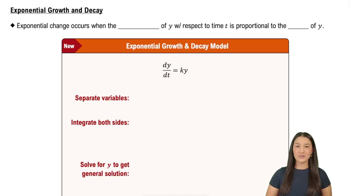
Exponential Growth and Decay

Exponential growth describes processes where quantities increase at rates proportional to their current size, such as tumor cells doubling every fixed time period. Conversely, exponential decay models processes where quantities decrease proportionally over time, like the volume loss of quiescent cells. Understanding these models helps predict tumor size changes over time.
추천 영상:
09:29
Exponential Growth & Decay

Clonogenic vs. Quiescent Cells

Clonogenic cells are actively dividing tumor cells responsible for rapid growth, while quiescent cells are non-dividing and metabolically less active, often shrinking over time. Differentiating these cell types is crucial to model tumor dynamics accurately after treatment, as their growth and decay behaviors differ significantly.
추천 영상:
03:30
The Power Rule: Negative & Rational Exponents Example 3

Piecewise Function Modeling

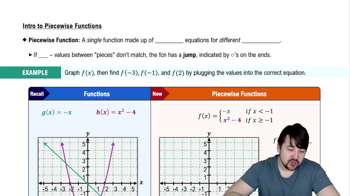
Piecewise functions allow modeling of systems with different behaviors in distinct time intervals or conditions. In this problem, the tumor volume changes due to two cell populations with different growth/decay rates, requiring a combined model that accounts for the initial rapid growth and subsequent decay phases to plot V(t) accurately.
추천 영상:
가이드 코스
05:36
Piecewise Functions
관련 실천