
Ch. 7 - Logarithmic, Exponential Functions, and Hyperbolic Functions
Briggs - Calculus: Early Transcendentals 3rd Edition
Briggs3rd EditionCalculus: Early TranscendentalsISBN: 9780136847243당신이 사용하는 게 아니라요?교과서 변경
7장, 문제 7.1.67b

Explain why or why not Determine whether the following statements are true and give an explanation or counterexample. Assume x > 0 and y > 0.


b. ln 0 = 1

검증된 단계별 안내
1
Recall the definition of the natural logarithm function: \(\ln x\) is the inverse of the exponential function \(e^x\), meaning \(\ln x = y\) if and only if \(e^y = x\).
Consider the value \(\ln 0\). To find this, we ask: for what value of \(y\) does \(e^y = 0\) hold true?
Since the exponential function \(e^y\) is always positive for all real numbers \(y\) (i.e., \(e^y > 0\) for all \(y\)), it never equals zero.
Therefore, there is no real number \(y\) such that \(e^y = 0\), which means \(\ln 0\) is undefined and does not equal 1 or any other real number.
In conclusion, the statement \(\ln 0 = 1\) is false because \(\ln 0\) is not defined in the real numbers.

비슷한 문제에 대한 검증된 영상 답변:

이 영상 해법은 위 문제에 도움이 된다고 튜터들이 추천한 것입니다.
영상 길이:
1m
도움이 되었나요?

주요 개념

질문에 올바르게 답하기 위해 반드시 이해해야 하는 핵심 개념들은 다음과 같습니다.

Definition and Domain of the Natural Logarithm Function

The natural logarithm function, ln(x), is defined only for positive real numbers (x > 0). It represents the inverse of the exponential function e^x, meaning ln(x) answers the question: 'To what power must e be raised to get x?' Since 0 is not positive, ln(0) is undefined.
추천 영상:
05:18
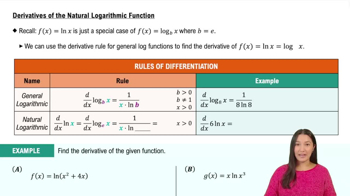
Derivative of the Natural Logarithmic Function

Behavior of ln(x) as x Approaches Zero

As x approaches 0 from the positive side, ln(x) decreases without bound, tending toward negative infinity. This means ln(0) is not a finite number and certainly not equal to 1. Understanding this limit helps clarify why ln(0) is undefined.
추천 영상:
05:36
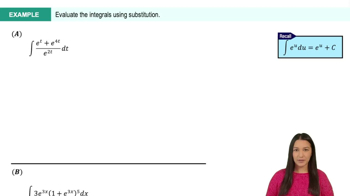
Integrals of Natural Exponential Functions (e^x) Example 3

Evaluating the Truth of Mathematical Statements

To determine if a statement like 'ln 0 = 1' is true, one must check the domain and properties of the functions involved. Since ln(0) is undefined, the statement is false. Providing a counterexample or referencing the function's domain is essential in justifying such claims.
추천 영상:
5:14
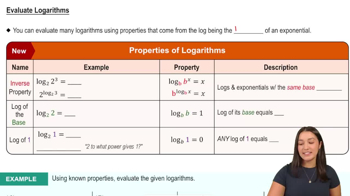
Evaluate Logarithms
관련 실천
교과서 질문

Oil consumption Starting in 2018 (t=0), the rate at which oil is consumed by a small country increases at a rate of 1.5%/yr, starting with an initial rate of 1.2 million barrels/yr.


b. Find the function that gives the amount of oil consumed between t=0 and any future time t.

51
views
교과서 질문

Properties of exp(x) Use the inverse relations between ln x and exp(x), and the properties of ln x, to prove the following properties:


b. exp(x − y) = exp(x) / exp(y)

83
views
교과서 질문

Theorem 7.8

Differentiate sinh⁻¹ x = ln (x + √(x² + 1)) to show that d/dx (sinh⁻¹ x) = 1 / √(x² + 1).

79
views
교과서 질문

61–62. Points of intersection and area

b. Compute the area of the region described.


f(x) = sinh x, g(x) = tanh x; the region bounded by the graphs of f, g, and x = ln 3

47
views
교과서 질문

A running model A model for the startup of a runner in a short race results in the velocity function v(t) = a(1 - e⁻ᵗ/ᶜ), where a and c are positive constants, t is measured in seconds, and v has units of m/s. (Source: Joe Keller, A Theory of Competitive Running, Physics Today, 26, Sep 1973)


b. Using the velocity in part (a) and assuming s(0) = 0, find the position function s(t), for t ≥ 0.

57
views
교과서 질문

A slowing race Starting at the same time and place, Abe and Bob race, running at velocities u(t) = 4 / (t + 1) mi/hr and v(t) = 4e^(−t/2) mi/hr, respectively, for t ≥ 0.

b. Find and graph the position functions of both runners. Which runner can run only a finite distance in an unlimited amount of time?

54
views