Ch. 7 - Logarithmic, Exponential Functions, and Hyperbolic Functions
Briggs - Calculus: Early Transcendentals 3rd Edition
Briggs3rd EditionCalculus: Early TranscendentalsISBN: 9780136847243당신이 사용하는 게 아니라요?교과서 변경
7장, 문제 7.1.77

Harmonic sum In Chapter 10, we will encounter the harmonic sum 1 + 1/2 + 1/3 + ⋯ + 1/n. Use a left Riemann sum to approximate ∫[1 to n+1] (dx/x) (with unit spacing between the grid points) to show that 1 + 1/2 + 1/3 + ⋯ + 1/n > ln(n + 1). Use this fact to conclude that lim (n → ∞) (1 + 1/2 + 1/3 + ⋯ + 1/n) does not exist.

검증된 단계별 안내
1
Recall that the integral \( \int_1^{n+1} \frac{1}{x} \, dx \) represents the area under the curve \( y = \frac{1}{x} \) from \( x=1 \) to \( x=n+1 \). This integral evaluates to \( \ln(n+1) \).
Set up a left Riemann sum with unit spacing to approximate the integral \( \int_1^{n+1} \frac{1}{x} \, dx \). The left endpoints for the subintervals are \( x = 1, 2, 3, \ldots, n \), so the sum is \( \sum_{k=1}^n \frac{1}{k} \cdot 1 = 1 + \frac{1}{2} + \frac{1}{3} + \cdots + \frac{1}{n} \).
Since \( \frac{1}{x} \) is a decreasing function, the left Riemann sum overestimates the integral. Therefore, we have the inequality \( 1 + \frac{1}{2} + \frac{1}{3} + \cdots + \frac{1}{n} > \int_1^{n+1} \frac{1}{x} \, dx = \ln(n+1) \).
Use this inequality to analyze the behavior of the harmonic sum as \( n \to \infty \). Because \( \ln(n+1) \to \infty \) as \( n \to \infty \), the harmonic sum \( 1 + \frac{1}{2} + \frac{1}{3} + \cdots + \frac{1}{n} \) must also grow without bound.
Conclude that the limit \( \lim_{n \to \infty} \left(1 + \frac{1}{2} + \frac{1}{3} + \cdots + \frac{1}{n}\right) \) does not exist as a finite number, since the harmonic sum diverges to infinity.

비슷한 문제에 대한 검증된 영상 답변:

이 영상 해법은 위 문제에 도움이 된다고 튜터들이 추천한 것입니다.
영상 길이:
3m
도움이 되었나요?

주요 개념

질문에 올바르게 답하기 위해 반드시 이해해야 하는 핵심 개념들은 다음과 같습니다.

Harmonic Series

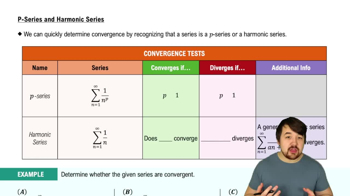
The harmonic series is the sum of reciprocals of natural numbers: 1 + 1/2 + 1/3 + ... + 1/n. It grows without bound as n increases, but very slowly. Understanding its divergence is key to analyzing its behavior compared to integrals and logarithmic functions.
추천 영상:
가이드 코스
04:30
P-Series and Harmonic Series

Left Riemann Sum Approximation

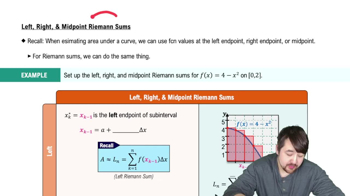
A left Riemann sum approximates the integral of a function by summing the areas of rectangles using the function's value at the left endpoint of each subinterval. For f(x) = 1/x on [1, n+1] with unit spacing, this sum corresponds to the harmonic sum, linking discrete sums to continuous integrals.
추천 영상:
가이드 코스
07:39
Left, Right, & Midpoint Riemann Sums

Improper Integral and Limit Comparison

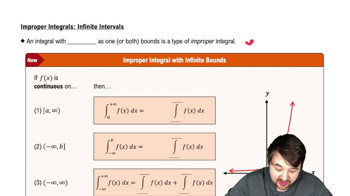
The integral ∫[1 to n+1] (1/x) dx equals ln(n+1), which grows without bound as n → ∞. Comparing the harmonic sum to this integral shows the sum exceeds ln(n+1), proving the harmonic series diverges and its limit does not exist (it tends to infinity).
추천 영상:
가이드 코스
11:11
Improper Integrals: Infinite Intervals