Ch. 7 - Logarithmic, Exponential Functions, and Hyperbolic Functions
Briggs - Calculus: Early Transcendentals 3rd Edition
Briggs3rd EditionCalculus: Early TranscendentalsISBN: 9780136847243당신이 사용하는 게 아니라요?교과서 변경
7장, 문제 7.R.29b

Log-normal probability distribution A commonly used distribution in probability and statistics is the log-normal distribution. (If the logarithm of a variable has a normal distribution, then the variable itself has a log-normal distribution.) The distribution function is
f(x) = 1/xσ√(2π) e⁻ˡⁿ^² ˣ / ²σ^², for x ≥ 0
where ln x has zero mean and standard deviation σ > 0.
b. Evaluate lim x → 0 ƒ(x). (Hint: Let x = eʸ.)

검증된 단계별 안내
1
Start by writing down the given probability density function (pdf) for the log-normal distribution: \(f(x) = \frac{1}{x \sigma \sqrt{2\pi}} e^{-\frac{(\ln x)^2}{2 \sigma^2}}\), for \(x \geq 0\).
To evaluate the limit as \(x\) approaches 0, use the hint and substitute \(x = e^y\). This means as \(x \to 0^+\), we have \(y = \ln x \to -\infty\).
Rewrite the function in terms of \(y\): \(f(e^y) = \frac{1}{e^y \sigma \sqrt{2\pi}} e^{-\frac{y^2}{2 \sigma^2}} = \frac{1}{\sigma \sqrt{2\pi}} e^{-y} e^{-\frac{y^2}{2 \sigma^2}}\).
Combine the exponents to get a single exponential expression: \(f(e^y) = \frac{1}{\sigma \sqrt{2\pi}} e^{-y - \frac{y^2}{2 \sigma^2}}\).
Analyze the behavior of the exponent \(-y - \frac{y^2}{2 \sigma^2}\) as \(y \to -\infty\). This will help determine the limit of \(f(x)\) as \(x \to 0^+\).

비슷한 문제에 대한 검증된 영상 답변:

이 영상 해법은 위 문제에 도움이 된다고 튜터들이 추천한 것입니다.
영상 길이:
2m
도움이 되었나요?

주요 개념

질문에 올바르게 답하기 위해 반드시 이해해야 하는 핵심 개념들은 다음과 같습니다.

Log-normal Distribution

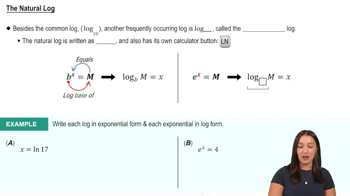
A log-normal distribution describes a random variable whose logarithm is normally distributed. If Y = ln(X) follows a normal distribution, then X is log-normally distributed. This distribution is skewed and only defined for positive values, commonly used in modeling multiplicative processes.
추천 영상:
2:51
The Natural Log

Limit Evaluation Using Substitution

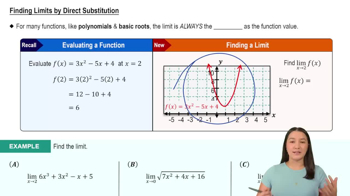
Evaluating limits involving complex functions often requires substitution to simplify the expression. Here, substituting x = e^y transforms the limit as x approaches 0 into a limit as y approaches -∞, making it easier to analyze the behavior of the function near zero.
추천 영상:
05:21
Finding Limits by Direct Substitution

Behavior of Exponential and Logarithmic Functions at Infinity

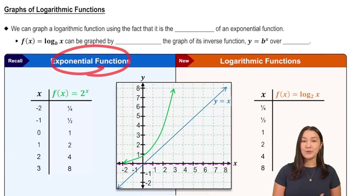
Understanding how exponential and logarithmic functions behave as their arguments approach infinity or negative infinity is crucial. For example, e^y approaches 0 as y → -∞, and ln(x) approaches -∞ as x → 0+, which helps in evaluating limits involving these functions.
추천 영상:
5:26
Graphs of Logarithmic Functions