
교과서 질문
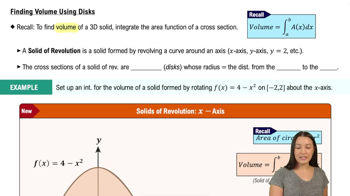
101. Comparing volumes Let R be the region bounded by the graph of y = sin(x) and the x-axis on the interval [0, π]. Which is greater, the volume of the solid generated when R is revolved about the x-axis or about the y-axis?
98
views

 검증된 단계별 안내
 04:48
04:48
 07:33
07:33 06:21
06:21101. Comparing volumes Let R be the region bounded by the graph of y = sin(x) and the x-axis on the interval [0, π]. Which is greater, the volume of the solid generated when R is revolved about the x-axis or about the y-axis?
109. Average velocity Find the average velocity of a projectile whose velocity over the interval 0 ≤ t ≤ π is given by
v(t) = 10 * sin(3t).
89–91. Comparison Test Determine whether the following integrals converge or diverge.
89. ∫ (from 1 to ∞) dx/(x⁵ + x⁴ + x³ + 1)
125. Wallis products Complete the following steps to prove a well-known formula discovered by the 17th-century English mathematician John Wallis.
a. Use a reduction formula to show that ∫ from 0 to π of (sin^m x) dx = (m − 1)/m × ∫ from 0 to π of (sin^(m−2) x) dx, for any integer m ≥ 2.
2–74. Integration techniques Use the methods introduced in Sections 8.1 through 8.5 to evaluate the following integrals.
40. ∫ (x² - 4)/(x + 4) dx
Explain why or why not. Determine whether the following statements are true and give an explanation or counterexample.
e. The best approach to evaluating ∫(x³ + 1)/(3x²) dx is to use the change of variables u = x³ + 1.