Ch. 8 - Integration Techniques
Briggs - Calculus: Early Transcendentals 3rd Edition
Briggs3rd EditionCalculus: Early TranscendentalsISBN: 9780136847243당신이 사용하는 게 아니라요?교과서 변경
8장, 문제 8.8.12

11-14. {Use of Tech} Compute the absolute and relative errors in using c to approximate x.
12. x = √2; c = 1.414

검증된 단계별 안내
1
Step 1: Understand the problem. You are tasked with calculating the absolute and relative errors when using the approximation c = 1.414 for the exact value x = √2. Absolute error measures the difference between the exact value and the approximation, while relative error measures the absolute error relative to the exact value.
Step 2: Write the formula for absolute error. The absolute error is given by: Absolute Error=|x-c|. Substitute x = √2 and c = 1.414 into this formula.
Step 3: Write the formula for relative error. The relative error is given by: Relative Error=|x-c|x. Again, substitute x = √2 and c = 1.414 into this formula.
Step 4: Compute the value of √2. Recall that √2 is an irrational number approximately equal to 1.41421356. Use this value for x in the formulas for absolute and relative errors.
Step 5: Perform the subtraction and division operations as required by the formulas. For absolute error, calculate |1.41421356-1.414|. For relative error, divide the absolute error by 1.41421356. These steps will yield the absolute and relative errors.

비슷한 문제에 대한 검증된 영상 답변:

이 영상 해법은 위 문제에 도움이 된다고 튜터들이 추천한 것입니다.
영상 길이:
1m
도움이 되었나요?

주요 개념

질문에 올바르게 답하기 위해 반드시 이해해야 하는 핵심 개념들은 다음과 같습니다.

Absolute Error

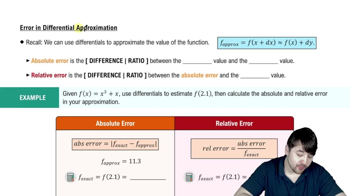
Absolute error measures the difference between the true value and the approximate value. It is calculated as the absolute value of the difference: |true value - approximate value|. In this case, the true value is √2, and the approximate value is c (1.414). This concept helps quantify how close the approximation is to the actual value.
추천 영상:
04:57
Determining Error and Relative Error

Relative Error

Relative error provides a measure of the size of the absolute error in relation to the true value. It is calculated by dividing the absolute error by the true value, often expressed as a percentage: (absolute error / true value) × 100%. This concept is useful for understanding the accuracy of an approximation in a relative context, especially when dealing with different scales.
추천 영상:
04:57
Determining Error and Relative Error

Approximation

An approximation is a value or expression that is close to, but not exactly equal to, a true value. In calculus and numerical analysis, approximations are often used to simplify complex calculations or to estimate values that are difficult to compute exactly. Understanding how to evaluate the quality of an approximation, through absolute and relative errors, is essential for assessing its usefulness in practical applications.
추천 영상:
04:57
Determining Error and Relative Error