
Ch. 8 - Integration Techniques
Briggs - Calculus: Early Transcendentals 3rd Edition
Briggs3rd EditionCalculus: Early TranscendentalsISBN: 9780136847243당신이 사용하는 게 아니라요?교과서 변경
8장, 문제 8.5.20

17-22. Give the partial fraction decomposition for the following expressions.
20. (x² - 4x + 11) / ((x - 3)(x - 1)(x + 1))

검증된 단계별 안내
1
Identify the form of the partial fraction decomposition. Since the denominator is a product of three distinct linear factors \((x - 3)\), \((x - 1)\), and \((x + 1)\), the decomposition will be of the form: \[\frac{A}{x - 3} + \frac{B}{x - 1} + \frac{C}{x + 1}\]
Write the equation equating the original fraction to the sum of partial fractions: \[\frac{x^{2} - 4x + 11}{(x - 3)(x - 1)(x + 1)} = \frac{A}{x - 3} + \frac{B}{x - 1} + \frac{C}{x + 1}\]
Multiply both sides of the equation by the common denominator \((x - 3)(x - 1)(x + 1)\) to clear the denominators: \[x^{2} - 4x + 11 = A(x - 1)(x + 1) + B(x - 3)(x + 1) + C(x - 3)(x - 1)\]
Expand each product on the right-hand side and combine like terms to express the right side as a polynomial in \(x\): - Expand \(A(x - 1)(x + 1)\) - Expand \(B(x - 3)(x + 1)\) - Expand \(C(x - 3)(x - 1)\) Then combine all terms to get a polynomial in the form \(Px^{2} + Qx + R\).
Set the coefficients of corresponding powers of \(x\) on both sides equal to each other to form a system of equations: - Coefficient of \(x^{2}\): Left side equals Right side - Coefficient of \(x\): Left side equals Right side - Constant term: Left side equals Right side Solve this system for \(A\), \(B\), and \(C\).

비슷한 문제에 대한 검증된 영상 답변:

이 영상 해법은 위 문제에 도움이 된다고 튜터들이 추천한 것입니다.
영상 길이:
7m
도움이 되었나요?

주요 개념

질문에 올바르게 답하기 위해 반드시 이해해야 하는 핵심 개념들은 다음과 같습니다.

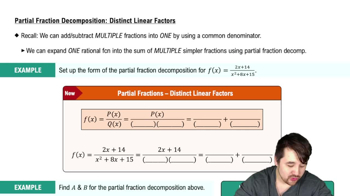
Partial Fraction Decomposition

Partial fraction decomposition is a technique used to express a rational function as a sum of simpler fractions with linear or quadratic denominators. This method is especially useful for integrating rational functions or simplifying expressions. The goal is to rewrite the given fraction into a form where each term has a simpler denominator.
추천 영상:
10:07
Partial Fraction Decomposition: Distinct Linear Factors

Factoring the Denominator

Factoring the denominator into linear or irreducible quadratic factors is essential before performing partial fraction decomposition. In this problem, the denominator is already factored as (x - 3)(x - 1)(x + 1), which allows us to set up the decomposition with terms corresponding to each linear factor.
추천 영상:
06:11
Limits of Rational Functions: Denominator = 0

Setting Up and Solving for Coefficients

After expressing the rational function as a sum of fractions with unknown coefficients, you multiply both sides by the common denominator to clear fractions. Then, equate coefficients of corresponding powers of x or substitute convenient x-values to solve for the unknown constants, completing the decomposition.
추천 영상:
5:02
Solving Logarithmic Equations