1. Give some examples of analytical methods for evaluating integrals.
Ch. 8 - Integration Techniques
8장, 문제 8.8.21
19-22. {Use of Tech} Trapezoid Rule approximations. Find the indicated Trapezoid Rule approximations to the following integrals.
21. ∫(0 to 1) sin(πx) dx using n = 6 subintervals
검증된 단계별 안내1
Understand the Trapezoid Rule formula: The Trapezoid Rule approximates the integral of a function f(x) over [a, b] using n subintervals. The formula is: , where x₁, x₂, ..., xₙ₋₁ are the points dividing the interval into n subintervals.
Identify the given values: Here, the integral is , the interval is [0, 1], and the number of subintervals is n = 6.
Calculate the width of each subinterval (h): The width is given by . Substituting a = 0, b = 1, and n = 6, compute h.
Determine the x-values for the subintervals: Divide the interval [0, 1] into 6 subintervals using the width h. The x-values will be . Write down these values explicitly.
Apply the Trapezoid Rule formula: Evaluate at each x-value (x₀, x₁, ..., x₆). Substitute these values into the Trapezoid Rule formula to approximate the integral.

비슷한 문제에 대한 검증된 영상 답변:
이 영상 해법은 위 문제에 도움이 된다고 튜터들이 추천한 것입니다.
영상 길이:
5m도움이 되었나요?
주요 개념
질문에 올바르게 답하기 위해 반드시 이해해야 하는 핵심 개념들은 다음과 같습니다.
Trapezoidal Rule
The Trapezoidal Rule is a numerical method used to approximate the definite integral of a function. It works by dividing the area under the curve into trapezoids rather than rectangles, providing a better approximation. The formula involves calculating the average of the function values at the endpoints of each subinterval and multiplying by the width of the subintervals.
추천 영상:
가이드 코스
Power Rules
Subintervals
Subintervals are segments into which the interval of integration is divided when applying numerical methods like the Trapezoidal Rule. In this case, with n = 6, the interval from 0 to 1 is divided into six equal parts, each with a width of 1/6. The choice of the number of subintervals affects the accuracy of the approximation.
추천 영상:
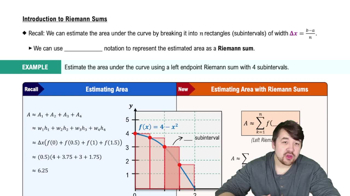
Introduction to Riemann Sums
Definite Integral
A definite integral represents the signed area under a curve defined by a function over a specific interval. It is denoted as ∫(a to b) f(x) dx, where 'a' and 'b' are the limits of integration. The definite integral can be interpreted both geometrically and analytically, and it is fundamental in calculating total quantities such as area, volume, and accumulated change.
추천 영상:
Definition of the Definite Integral
관련 실천
교과서 질문
119
views
교과서 질문
9–40. Integration by parts Evaluate the following integrals using integration by parts.
38. ∫ x² ln²(x) dx
91
views
교과서 질문
9–61. Trigonometric integrals Evaluate the following integrals.
19. ∫[0 to π/3] sin⁵x cos⁻²x dx
68
views
교과서 질문
7–40. Table look-up integrals Use a table of integrals to evaluate the following indefinite integrals. Some of the integrals require preliminary work, such as completing the square or changing variables, before they can be found in a table.
8. ∫ sin 3x cos 2x dx
49
views
교과서 질문
9–61. Trigonometric integrals Evaluate the following integrals.
50. ∫ csc¹⁰x cot³x dx
79
views
교과서 질문
Clever substitution Evaluate ∫ dx/(1 + sin x + cos x) using the substitution x=2 tan⁻¹ θ. The identities sin x = 2 sin(x/2) cos(x/2) and cos x =cos²(x/2) − sin²(x/2) are helpful.
39
views