Ch. 8 - Integration Techniques
Briggs - Calculus: Early Transcendentals 3rd Edition
Briggs3rd EditionCalculus: Early TranscendentalsISBN: 9780136847243당신이 사용하는 게 아니라요?교과서 변경
8장, 문제 8.8.27

27. {Use of Tech} Midpoint Rule, Trapezoid Rule, and relative error
Find the Midpoint and Trapezoid Rule approximations to ∫(0 to 1) sin(πx) dx using n = 25 subintervals. Compute the relative error of each approximation.

검증된 단계별 안내
1
Step 1: Understand the problem. You are tasked with approximating the integral ∫(0 to 1) sin(πx) dx using two numerical methods: the Midpoint Rule and the Trapezoid Rule, with n = 25 subintervals. Additionally, you need to compute the relative error for each approximation.
Step 2: Divide the interval [0, 1] into n = 25 subintervals. The width of each subinterval, denoted as Δx, is calculated as Δx = (b - a) / n, where a = 0 and b = 1. Thus, Δx = 1 / 25.
Step 3: Apply the Midpoint Rule. For the Midpoint Rule, the approximation is given by: M = Δx * Σ(f(xᵢ)), where xᵢ is the midpoint of each subinterval. The midpoints are calculated as xᵢ = a + (i - 0.5)Δx for i = 1, 2, ..., n. Evaluate f(xᵢ) = sin(πxᵢ) at each midpoint and sum the results.
Step 4: Apply the Trapezoid Rule. For the Trapezoid Rule, the approximation is given by: T = (Δx / 2) * [f(a) + 2Σ(f(xᵢ)) + f(b)], where xᵢ are the endpoints of the subintervals. Evaluate f(xᵢ) = sin(πxᵢ) at each endpoint and sum the results.
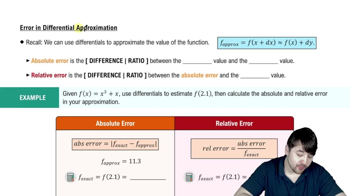
Step 5: Compute the relative error for each approximation. The relative error is calculated as: Relative Error = |(Exact Value - Approximation) / Exact Value|. The exact value of the integral ∫(0 to 1) sin(πx) dx can be computed analytically as -cos(πx) evaluated from 0 to 1, which simplifies to 2/π. Use this exact value to compute the relative error for both the Midpoint and Trapezoid Rule approximations.

비슷한 문제에 대한 검증된 영상 답변:

이 영상 해법은 위 문제에 도움이 된다고 튜터들이 추천한 것입니다.
영상 길이:
11m
도움이 되었나요?

주요 개념

질문에 올바르게 답하기 위해 반드시 이해해야 하는 핵심 개념들은 다음과 같습니다.

Midpoint Rule

The Midpoint Rule is a numerical integration technique that approximates the area under a curve by dividing it into subintervals and using the midpoint of each subinterval to calculate the height of rectangles. For each subinterval, the function value at the midpoint is multiplied by the width of the subinterval, and the sum of these areas gives the total approximation of the integral.
추천 영상:

Trapezoid Rule

The Trapezoid Rule is another numerical method for estimating the value of a definite integral. It approximates the area under a curve by dividing the interval into subintervals and forming trapezoids rather than rectangles. The area of each trapezoid is calculated using the average of the function values at the endpoints of each subinterval, multiplied by the width of the subinterval, and the total area is the sum of these trapezoidal areas.
추천 영상:

Relative Error

Relative error is a measure of the accuracy of an approximation compared to the exact value. It is calculated by taking the absolute difference between the exact value and the approximation, dividing it by the exact value, and often expressing it as a percentage. This metric helps to assess how close the numerical approximation is to the true value of the integral, providing insight into the effectiveness of the numerical methods used.
추천 영상:
04:57
Determining Error and Relative Error