Ch. 8 - Integration Techniques
Briggs - Calculus: Early Transcendentals 3rd Edition
Briggs3rd EditionCalculus: Early TranscendentalsISBN: 9780136847243당신이 사용하는 게 아니라요?교과서 변경
8장, 문제 8.8.42a

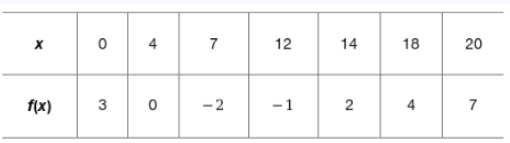
42. Approximating integrals The function f is twice differentiable on (-∞, ∞). Values of f at various points on [0, 20] are given in the table.
fig
a. Approximate ∫(0 to 120) f(x) dx in three way using a left Riemann sum, a right Riemann sum and the Trapezoid Rule

검증된 단계별 안내
1
Step 1: To approximate the integral ∫(0 to 20) f(x) dx, we will use three methods: the Left Riemann Sum, the Right Riemann Sum, and the Trapezoid Rule. First, note the given data points for x and f(x) from the table.
Step 2: For the Left Riemann Sum, use the formula: L = Σ f(x_i) * Δx, where x_i are the left endpoints of each subinterval. Calculate Δx for each subinterval (e.g., Δx = x_(i+1) - x_i) and multiply by the corresponding f(x) values at the left endpoints.
Step 3: For the Right Riemann Sum, use the formula: R = Σ f(x_(i+1)) * Δx, where x_(i+1) are the right endpoints of each subinterval. Again, calculate Δx for each subinterval and multiply by the corresponding f(x) values at the right endpoints.
Step 4: For the Trapezoid Rule, use the formula: T = (1/2) * Σ [f(x_i) + f(x_(i+1))] * Δx. Here, calculate the average of f(x) values at each pair of endpoints and multiply by the width of the subinterval Δx.
Step 5: Add up the contributions from all subintervals for each method (Left Riemann Sum, Right Riemann Sum, and Trapezoid Rule) to approximate the integral. Ensure that you use the correct Δx for each subinterval as given in the table.

비슷한 문제에 대한 검증된 영상 답변:

이 영상 해법은 위 문제에 도움이 된다고 튜터들이 추천한 것입니다.
영상 길이:
5m
도움이 되었나요?

주요 개념

질문에 올바르게 답하기 위해 반드시 이해해야 하는 핵심 개념들은 다음과 같습니다.

Riemann Sums

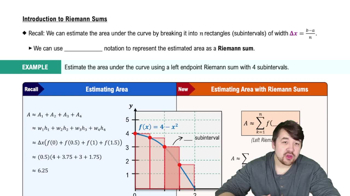
Riemann sums are a method for approximating the definite integral of a function over an interval. They involve partitioning the interval into subintervals and summing the areas of rectangles formed by evaluating the function at specific points, such as the left endpoint, right endpoint, or midpoint of each subinterval. This technique provides a way to estimate the area under the curve, which is the essence of integration.
추천 영상:
06:11
Introduction to Riemann Sums

Trapezoid Rule

The Trapezoid Rule is a numerical method for estimating the definite integral of a function by approximating the area under the curve as a series of trapezoids rather than rectangles. It calculates the area of each trapezoid formed between two points on the x-axis, using the average of the function values at these points. This method generally provides a more accurate approximation than Riemann sums, especially for functions that are linear or nearly linear over small intervals.
추천 영상:

Definite Integral

A definite integral represents the signed area under a curve defined by a function over a specific interval [a, b]. It is calculated as the limit of Riemann sums as the number of subintervals approaches infinity. The definite integral not only provides a numerical value representing the area but also has applications in various fields, such as physics and engineering, where it can represent quantities like distance, area, and volume.
추천 영상:
05:43
Definition of the Definite Integral
관련 실천
교과서 질문

Computing areas On the interval [0,2], the graphs of f(x)=x²/3 and g(x)=x²(9−x²)^(-1/2) have similar shapes.

a. Find the area of the region bounded by the graph of f and the x-axis on the interval [0,2].

72
views

교과서 질문

75. {Use of Tech} Oscillator displacements Suppose a mass on a spring that is slowed by friction has the position function:

s(t) = e⁻ᵗ sin t

a. Graph the position function. At what times does the oscillator pass through the position s = 0?

53
views
교과서 질문

A piece of wood paneling must be cut in the shape shown in the figure.

The coordinates of several points on its curved surface are also shown (with units of inches).

a. Estimate the surface area of the paneling using the Trapezoid Rule.

37
views
교과서 질문

41-44. {Use of Tech} Nonuniform grids

Use the indicated methods to solve the following problems with nonuniform grids.

41. A curling iron is plugged into an outlet at time t = 0. Its temperature T in degrees Fahrenheit, assumed to be a continuous function that is strictly increasing and concave down on 0 ≤ t ≤ 120, is given at various times (in seconds) in the table.

a. Approximate (1/120)∫(0 to 120)T(t)dt in three ways using a left Riemann sum, using a right Riemann sum and using the Trapezoid Rule

Interpret the value of (1/120)∫(0 to 120)T(t)dt in the context of this problem.

64
views
교과서 질문

66–71. {Use of Tech} Estimating error Refer to Theorem 8.1 in the following exercises.

69. Let f(x) = sin(eˣ).

a. Find a Trapezoid Rule approximation to ∫[0 to 1] sin(eˣ) dx using n = 40 subintervals.

48
views
교과서 질문

81. Possible and impossible integrals

Let Iₙ = ∫ xⁿ e⁻ˣ² dx, where n is a nonnegative integer.

a. I₀ = ∫ e⁻ˣ² dx cannot be expressed in terms of elementary functions. Evaluate I₁.

60
views