Ch. 8 - Integration Techniques
Briggs - Calculus: Early Transcendentals 3rd Edition
Briggs3rd EditionCalculus: Early TranscendentalsISBN: 9780136847243당신이 사용하는 게 아니라요?교과서 변경
8장, 문제 8.8.43c

43. A hot-air balloon is launched from an elevation of 5400 ft above sea level. As it rises, the vertical velocity is computed using a device (called a variometer) that measures the change in atmospheric pressure. The vertical velocities at selected times are shown in the table (with units of ft/min).
tab1
c. A polynomial that fits the data reasonably well is:
g(t) = 3.49t³ - 43.21t² + 142.43t - 1.75
Estimate the elevation of the balloon after five minutes using this polynomial.

검증된 단계별 안내
1
Step 1: Understand the problem. We are tasked with estimating the elevation of the hot-air balloon after 5 minutes using the given polynomial g(t) = 3.49t³ - 43.21t² + 142.43t - 1.75. The initial elevation of the balloon is 5400 ft above sea level.
Step 2: Recognize that the polynomial g(t) represents the vertical velocity of the balloon as a function of time t (in minutes). To find the elevation, we need to integrate g(t) with respect to t, as the elevation is the accumulation of vertical velocity over time.
Step 3: Set up the integral for the elevation. The elevation E(t) at time t is given by the integral of g(t) from 0 to t, plus the initial elevation. Mathematically, this is expressed as: E(t) = 5400 + ∫[0 to t] g(t) dt.
Step 4: Compute the indefinite integral of g(t). The integral of g(t) = 3.49t³ - 43.21t² + 142.43t - 1.75 is: ∫g(t) dt = (3.49/4)t⁴ - (43.21/3)t³ + (142.43/2)t² - 1.75t + C, where C is the constant of integration.
Step 5: Evaluate the definite integral from 0 to 5. Substitute t = 5 into the integrated polynomial and subtract the value of the polynomial at t = 0. Add the result to the initial elevation of 5400 ft to find the estimated elevation after 5 minutes.

비슷한 문제에 대한 검증된 영상 답변:

이 영상 해법은 위 문제에 도움이 된다고 튜터들이 추천한 것입니다.
영상 길이:
3m
도움이 되었나요?

주요 개념

질문에 올바르게 답하기 위해 반드시 이해해야 하는 핵심 개념들은 다음과 같습니다.

Polynomial Functions

A polynomial function is a mathematical expression involving a sum of powers in one or more variables multiplied by coefficients. In this context, the polynomial g(t) = 3.49t³ - 43.21t² + 142.43t - 1.75 models the vertical velocity of the hot-air balloon over time. Understanding how to evaluate polynomial functions is crucial for estimating values, such as the elevation of the balloon after a specific time.
추천 영상:
07:00
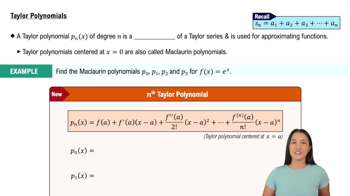
Taylor Polynomials

Integration

Integration is a fundamental concept in calculus that allows us to find the accumulated value of a function over an interval. In this scenario, to estimate the elevation of the balloon after five minutes, we need to integrate the velocity function g(t) over the interval from 0 to 5 minutes. This process gives us the total change in elevation, which we then add to the initial elevation of 5400 ft.
추천 영상:
06:18
Integration by Parts for Definite Integrals

Initial Conditions

Initial conditions refer to the starting values of a function at a specific point, which are essential for solving differential equations or evaluating functions. In this problem, the initial elevation of the hot-air balloon is 5400 ft above sea level. This value is critical as it serves as the baseline from which we calculate the balloon's elevation after applying the results from the integration of the velocity function.
추천 영상:
05:03
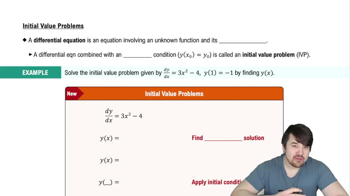
Initial Value Problems
관련 실천
교과서 질문

45–48. {Use of Tech} Trapezoid Rule and Simpson’s Rule Consider the following integrals and the given values of n.

48. ∫(0 to π/4) (1/(1 + x²)) dx; n = 64

c. Compute the absolute errors in the Trapezoid Rule and Simpson’s Rule with 2n subintervals.

68
views
교과서 질문

109. Escape velocity and black holes The work required to launch an object from the surface of Earth to outer space is given by W = ∫ from R to ∞ of F(x) dx, where R = 6370 km is the approximate radius of Earth, F(x) = (GMm)/x² is the gravitational force between Earth and the object, G is the gravitational constant, M is the mass of Earth, m is the mass of the object, and GM = 4 × 10¹⁴ m³/s².

c. The French scientist Laplace anticipated the existence of black holes in the 18th century with the following argument: If a body has an escape velocity that equals or exceeds the speed of light, c = 300,000 km/s, then light cannot escape the body and it cannot be seen. Show that such a body has a radius R ≤ 2GM/c². For Earth to be a black hole, what would its radius need to be?

53
views
교과서 질문

45–48. {Use of Tech} Trapezoid Rule and Simpson’s Rule Consider the following integrals and the given values of n.

47. ∫(1 to e) (1/x) dx; n = 50

c. Compute the absolute errors in the Trapezoid Rule and Simpson’s Rule with 2n subintervals.

62
views
교과서 질문

Computing areas On the interval [0,2], the graphs of f(x)=x²/3 and g(x)=x²(9−x²)^(-1/2) have similar shapes.

c. Which region has greater area?

64
views
교과서 질문

60. Two Methods

c. Verify that your answers to parts (a) and (b) are consistent.

37
views
교과서 질문

75. {Use of Tech} Oscillator displacements Suppose a mass on a spring that is slowed by friction has the position function:

s(t) = e⁻ᵗ sin t

c. Generalize part (b) and find the average value of the position on the interval [nπ, (n+1)π], for n = 0, 1, 2, ...

35
views