
Ch. 8 - Integration Techniques
Briggs - Calculus: Early Transcendentals 3rd Edition
Briggs3rd EditionCalculus: Early TranscendentalsISBN: 9780136847243당신이 사용하는 게 아니라요?교과서 변경
8장, 문제 8.8.67d

66–71. {Use of Tech} Estimating error Refer to Theorem 8.1 in the following exercises.
67. Let f(x) = √(x³ + 1).
d. Use Theorem 8.1 to find an upper bound on the absolute error in the estimate found in part (a).

검증된 단계별 안내
1
Step 1: Recall Theorem 8.1, which provides a method to estimate the error in numerical integration. The theorem states that the absolute error is bounded by \( \frac{K(b-a)^3}{24n^2} \), where \( K \) is the maximum value of the second derivative of \( f(x) \) on the interval \( [a, b] \), \( n \) is the number of subintervals, and \( [a, b] \) is the interval of integration.
Step 2: Compute the second derivative of \( f(x) = \sqrt{x^3 + 1} \). Start by finding the first derivative \( f'(x) \) using the chain rule: \( f'(x) = \frac{1}{2\sqrt{x^3 + 1}} \cdot 3x^2 \). Then, differentiate \( f'(x) \) again to find \( f''(x) \).
Step 3: Determine the maximum value of \( f''(x) \) on the interval \( [a, b] \). This involves analyzing \( f''(x) \) and finding its critical points by setting \( f''(x) = 0 \) and solving for \( x \). Evaluate \( f''(x) \) at the critical points and endpoints of the interval to find the maximum value \( K \).
Step 4: Substitute the values of \( K \), \( b-a \) (the length of the interval), and \( n \) (the number of subintervals) into the formula \( \frac{K(b-a)^3}{24n^2} \) to calculate the upper bound on the absolute error.
Step 5: Interpret the result. The computed upper bound represents the maximum possible error in the numerical integration estimate found in part (a). This provides a measure of the reliability of the approximation.

비슷한 문제에 대한 검증된 영상 답변:

이 영상 해법은 위 문제에 도움이 된다고 튜터들이 추천한 것입니다.
영상 길이:
3m
도움이 되었나요?

주요 개념

질문에 올바르게 답하기 위해 반드시 이해해야 하는 핵심 개념들은 다음과 같습니다.

Theorem 8.1 (Error Estimation)

Theorem 8.1 provides a method for estimating the error in numerical approximations of functions. It typically states that the absolute error can be bounded by considering the derivative of the function and the interval of approximation. This theorem is crucial for understanding how close an estimated value is to the actual value, especially in calculus applications involving limits and derivatives.
추천 영상:
04:57
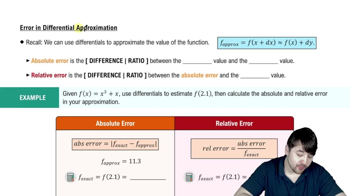
Determining Error and Relative Error

Absolute Error

Absolute error is the difference between the true value of a quantity and the value that is estimated or measured. It is expressed as a non-negative number, indicating how far off an estimate is from the actual value. In the context of calculus, understanding absolute error is essential for evaluating the accuracy of numerical methods and approximations.
추천 영상:
04:57
Determining Error and Relative Error

Derivatives and Their Role in Error Estimation

Derivatives represent the rate of change of a function and are fundamental in determining how a function behaves near a point. In error estimation, the derivative helps assess how sensitive a function is to changes in its input, which is critical for applying Theorem 8.1. By analyzing the derivative, one can establish bounds on the error, ensuring that the approximation remains within acceptable limits.
추천 영상:
04:46
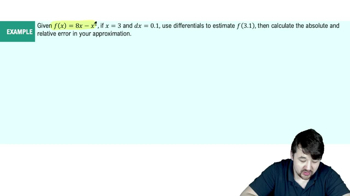
Determining Error and Relative Error Example 1
관련 실천
교과서 질문

The Eiffel Tower Property Let R be the region between the curves y = e^(-c·x) and y = -e^(-c·x) on the interval [a, ∞), where a ≥ 0 and c > 0.

The center of mass of R is located at (x̄, 0), where x̄ = [∫(a to ∞) x·e^(-c·x) dx] / [∫(a to ∞) e^(-c·x) dx]

(The profile of the Eiffel Tower is modeled by these two exponential curves; see the Guided Project "The exponential Eiffel Tower")

d. Prove this property holds for any a ≥ 0 and c > 0:

The tangent lines to y = ±e^(-c·x) at x = a always intersect at R's center of mass

(Source: P. Weidman and I. Pinelis, Comptes Rendu, Mechanique, 332, 571-584, 2004)

33
views
교과서 질문

81. Possible and impossible integrals

Let Iₙ = ∫ xⁿ e⁻ˣ² dx, where n is a nonnegative integer.

d. Show that, in general, if n is odd, then Iₙ = -½ e⁻ˣ² pₙ₋₁(x), where pₙ₋₁ is a polynomial of degree n - 1.

66
views
교과서 질문

57. Explain why or why not Determine whether the following statements are true and give an explanation or counterexample.

d. The integral ∫ dx/(x² + 4x + 9) cannot be evaluated using a trigonometric substitution.

43
views
교과서 질문

66–71. {Use of Tech} Estimating error Refer to Theorem 8.1 in the following exercises.

66. Let f(x) = cos(x²).

d. Use Theorem 8.1 to find an upper bound on the absolute error in the estimate found in part (a).

51
views
교과서 질문

Explain why or why not Determine whether the following statements are true and give an explanation or counterexample.

d. Using the substitution u = tan(x) in ∫ (tan²x / (tan x - 1)) dx leads to ∫ (u² / (u - 1)) du.

41
views
교과서 질문

2. Give an example of each of the following.

d. A repeated irreducible quadratic factor

102
views