Ch. 8 - Integration Techniques
Briggs - Calculus: Early Transcendentals 3rd Edition
Briggs3rd EditionCalculus: Early TranscendentalsISBN: 9780136847243당신이 사용하는 게 아니라요?교과서 변경
8장, 문제 8.4.23

7-56. Trigonometric substitutions Evaluate the following integrals using trigonometric substitution.
23. ∫ 1/(25 - x²)^(3/2) dx

검증된 단계별 안내
1
Step 1: Recognize the integral involves a term of the form \( a^2 - x^2 \), which suggests using the trigonometric substitution \( x = a \sin(\theta) \). Here, \( a = 5 \) because \( 25 = 5^2 \). Substitute \( x = 5 \sin(\theta) \), and compute \( dx = 5 \cos(\theta) d\theta \).
Step 2: Substitute \( x = 5 \sin(\theta) \) and \( dx = 5 \cos(\theta) d\theta \) into the integral. The term \( 25 - x^2 \) becomes \( 25 - 25 \sin^2(\theta) \), which simplifies to \( 25 \cos^2(\theta) \) using the Pythagorean identity \( \sin^2(\theta) + \cos^2(\theta) = 1 \).
Step 3: Rewrite the integral in terms of \( \theta \): \( \int \frac{1}{(25 \cos^2(\theta))^{3/2}} \cdot 5 \cos(\theta) d\theta \). Simplify the denominator \( (25 \cos^2(\theta))^{3/2} \) to \( 125 \cos^3(\theta) \). The integral becomes \( \int \frac{5 \cos(\theta)}{125 \cos^3(\theta)} d\theta \).
Step 4: Simplify the fraction \( \frac{5 \cos(\theta)}{125 \cos^3(\theta)} \) to \( \frac{1}{25 \cos^2(\theta)} \). The integral now becomes \( \int \frac{1}{25 \cos^2(\theta)} d\theta \), which can be rewritten as \( \frac{1}{25} \int \sec^2(\theta) d\theta \).
Step 5: Evaluate \( \int \sec^2(\theta) d\theta \), which is a standard integral equal to \( \tan(\theta) \). After finding \( \tan(\theta) \), use the substitution \( \theta = \arcsin(x/5) \) to express the result back in terms of \( x \).

비슷한 문제에 대한 검증된 영상 답변:

이 영상 해법은 위 문제에 도움이 된다고 튜터들이 추천한 것입니다.
영상 길이:
6m
도움이 되었나요?

주요 개념

질문에 올바르게 답하기 위해 반드시 이해해야 하는 핵심 개념들은 다음과 같습니다.

Trigonometric Substitution

Trigonometric substitution is a technique used in calculus to simplify integrals involving square roots of quadratic expressions. By substituting a variable with a trigonometric function, such as x = a sin(θ) or x = a tan(θ), the integral can often be transformed into a more manageable form. This method is particularly useful for integrals that contain expressions like √(a² - x²), √(x² + a²), or √(x² - a²).
추천 영상:
6:04
Introduction to Trigonometric Functions

Integral of Trigonometric Functions

Understanding the integrals of trigonometric functions is essential for evaluating integrals after substitution. Common integrals include ∫ sin(θ) dθ = -cos(θ) + C and ∫ cos(θ) dθ = sin(θ) + C. Familiarity with these integrals allows for the effective evaluation of the transformed integral, leading to the final solution after reverting back to the original variable.
추천 영상:
6:04
Introduction to Trigonometric Functions

Pythagorean Identity

The Pythagorean identity, sin²(θ) + cos²(θ) = 1, is a fundamental relationship in trigonometry that is often used in conjunction with trigonometric substitution. This identity helps simplify expressions involving trigonometric functions, especially when converting back to the original variable after integration. Recognizing how to manipulate this identity is crucial for solving integrals that arise from trigonometric substitutions.
추천 영상:
7:17
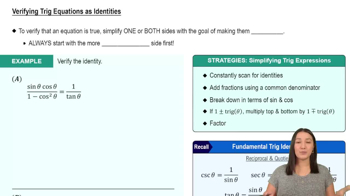
Verifying Trig Equations as Identities