Ch. 8 - Integration Techniques
Briggs - Calculus: Early Transcendentals 3rd Edition
Briggs3rd EditionCalculus: Early TranscendentalsISBN: 9780136847243당신이 사용하는 게 아니라요?교과서 변경
8장, 문제 8.9.36

7–58. Improper integrals Evaluate the following integrals or state that they diverge.
36. ∫ (from e² to ∞) 1/(x lnᵖ x) dx, p > 1

검증된 단계별 안내
1
Identify the integral to evaluate: \(\displaystyle \int_{e^{2}}^{\infty} \frac{1}{x (\ln x)^{p}} \, dx\) where \(p > 1\).
Recognize that this is an improper integral because the upper limit of integration is infinite. We rewrite it as a limit: \(\displaystyle \lim_{t \to \infty} \int_{e^{2}}^{t} \frac{1}{x (\ln x)^{p}} \, dx\).
Use the substitution \(u = \ln x\), which implies \(du = \frac{1}{x} dx\). This transforms the integral into \(\displaystyle \lim_{t \to \infty} \int_{\ln e^{2}}^{\ln t} \frac{1}{u^{p}} \, du\).
Simplify the limits of integration: since \(\ln e^{2} = 2\), the integral becomes \(\displaystyle \lim_{t \to \infty} \int_{2}^{\ln t} u^{-p} \, du\).
Evaluate the integral \(\int u^{-p} \, du\) for \(p \neq 1\), which is \(\frac{u^{-p+1}}{-p+1} + C\). Then apply the limits from 2 to \(\ln t\) and analyze the limit as \(t \to \infty\) to determine if the integral converges or diverges.

비슷한 문제에 대한 검증된 영상 답변:

이 영상 해법은 위 문제에 도움이 된다고 튜터들이 추천한 것입니다.
영상 길이:
6m
도움이 되었나요?

주요 개념

질문에 올바르게 답하기 위해 반드시 이해해야 하는 핵심 개념들은 다음과 같습니다.

Improper Integrals

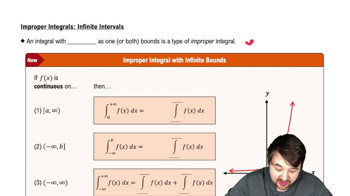
Improper integrals involve integration over an infinite interval or integrands with infinite discontinuities. To evaluate them, limits are used to define the integral as a limit of definite integrals over finite intervals. Determining convergence or divergence is essential for these integrals.
추천 영상:
11:11
Improper Integrals: Infinite Intervals

Convergence Tests for Improper Integrals

To determine if an improper integral converges, comparison tests or p-integral tests are applied. For integrals of the form ∫ 1/(x (ln x)^p) dx from a finite number to infinity, the behavior of the integrand as x approaches infinity dictates convergence, often depending on the exponent p.
추천 영상:
11:11
Improper Integrals: Infinite Intervals

Logarithmic Functions and Their Properties

Understanding the natural logarithm function ln(x) and its growth rate is crucial. Since ln(x) grows slower than any power of x, integrals involving ln(x) in the denominator require careful analysis of how powers of ln(x) affect convergence, especially in improper integrals extending to infinity.
추천 영상:
06:21
Properties of Functions