Ch. 8 - Integration Techniques
Briggs - Calculus: Early Transcendentals 3rd Edition
Briggs3rd EditionCalculus: Early TranscendentalsISBN: 9780136847243당신이 사용하는 게 아니라요?교과서 변경
8장, 문제 8.7.76

76. Apparent discrepancy
Three different computer algebra systems give the following results:
∫ (dx / (x√(x⁴ − 1))) = ½ cos⁻¹(√(x⁻⁴)) = ½ cos⁻¹(x⁻²) = ½ tan⁻¹(√(x⁴ − 1)).
Explain how all three can be correct.

검증된 단계별 안내
1
Step 1: Recognize that the integral ∫ (dx / (x√(x⁴ − 1))) involves inverse trigonometric functions, and different forms of these functions can represent the same mathematical relationship.
Step 2: Understand that the expressions ½ cos⁻¹(√(x⁻⁴)), ½ cos⁻¹(x⁻²), and ½ tan⁻¹(√(x⁴ − 1)) are equivalent but expressed differently due to trigonometric identities and transformations.
Step 3: Recall key trigonometric identities, such as cos⁻¹(u) + sin⁻¹(u) = π/2 and tan⁻¹(u) = sin⁻¹(u) / cos(u), which allow conversion between inverse trigonometric functions.
Step 4: Verify that the argument transformations (e.g., √(x⁻⁴) = x⁻² and √(x⁴ − 1)) are consistent with the domain and range of the integral, ensuring that all forms are valid representations.
Step 5: Conclude that the apparent discrepancy arises from different ways of expressing the same integral result, and all three forms are mathematically correct due to the equivalence of trigonometric identities.

비슷한 문제에 대한 검증된 영상 답변:

이 영상 해법은 위 문제에 도움이 된다고 튜터들이 추천한 것입니다.
영상 길이:
8m
도움이 되었나요?

주요 개념

질문에 올바르게 답하기 위해 반드시 이해해야 하는 핵심 개념들은 다음과 같습니다.

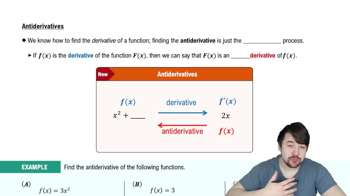
Integration and Antiderivatives

Integration is the process of finding the antiderivative of a function, which represents the area under the curve of that function. Different methods of integration, such as substitution or integration by parts, can yield different forms of the same antiderivative. This means that multiple expressions can represent the same integral, differing only by a constant or a change in variable.
추천 영상:
05:50
Antiderivatives

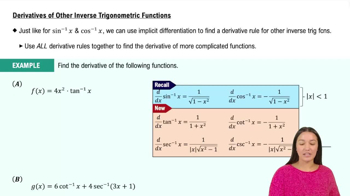
Inverse Trigonometric Functions

Inverse trigonometric functions, such as cos⁻¹ and tan⁻¹, are used to find angles when given a ratio of sides in a right triangle. These functions can have multiple representations due to their periodic nature and the different quadrants in which angles can lie. Understanding the relationships between these functions is crucial for recognizing how different forms of an expression can be equivalent.
추천 영상:
06:35
Derivatives of Other Inverse Trigonometric Functions

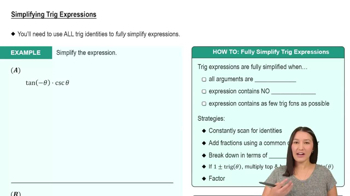
Equivalence of Expressions

Mathematically, two expressions are considered equivalent if they yield the same value for all inputs in their domain. In the context of integrals, different forms can arise from algebraic manipulation or the application of trigonometric identities. Recognizing that these forms can be transformed into one another through valid mathematical operations is essential for resolving apparent discrepancies in results.
추천 영상:
6:36
Simplifying Trig Expressions