
Ch. 8 - Integration Techniques
Briggs - Calculus: Early Transcendentals 3rd Edition
Briggs3rd EditionCalculus: Early TranscendentalsISBN: 9780136847243당신이 사용하는 게 아니라요?교과서 변경
8장, 문제 8.6.33

7–84. Evaluate the following integrals.
33. ∫ [eˣ / (a² + e²ˣ)] dx, where a ≠ 0

검증된 단계별 안내
1
Step 1: Recognize that the integral involves a rational function with an exponential term in the numerator and a sum of squares in the denominator. This suggests a substitution method might simplify the problem.
Step 2: Let u = eˣ. Then, differentiate u with respect to x to find du: du = eˣ dx. This substitution replaces eˣ dx in the integral with du.
Step 3: Rewrite the integral in terms of u. Since u = eˣ, the denominator becomes a² + u², and the integral becomes ∫ [u / (a² + u²)] du.
Step 4: Recognize that the new integral ∫ [u / (a² + u²)] du can be simplified using the derivative of the denominator. Specifically, the derivative of a² + u² with respect to u is 2u, which suggests a natural logarithm substitution.
Step 5: Apply the substitution and simplify the integral. The result will involve a logarithmic function, specifically ln(a² + u²), and then substitute back u = eˣ to express the solution in terms of x.

비슷한 문제에 대한 검증된 영상 답변:

이 영상 해법은 위 문제에 도움이 된다고 튜터들이 추천한 것입니다.
영상 길이:
4m
도움이 되었나요?

주요 개념

질문에 올바르게 답하기 위해 반드시 이해해야 하는 핵심 개념들은 다음과 같습니다.

Integration Techniques

Integration techniques are methods used to evaluate integrals, which can include substitution, integration by parts, and partial fractions. In this case, recognizing the form of the integrand, particularly the presence of the exponential function and the polynomial in the denominator, is crucial for selecting the appropriate technique to simplify the integral.
추천 영상:
06:18
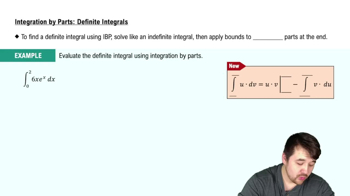
Integration by Parts for Definite Integrals

Exponential Functions

Exponential functions, such as eˣ, are functions of the form f(x) = a^x, where 'a' is a constant. They have unique properties, including the fact that their derivatives and integrals are also exponential functions. Understanding how to manipulate these functions is essential for evaluating integrals involving them, especially when combined with other algebraic expressions.
추천 영상:
6:13
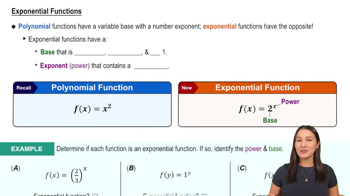
Exponential Functions

Improper Integrals

Improper integrals occur when the limits of integration are infinite or when the integrand approaches infinity within the interval of integration. In this problem, recognizing whether the integral converges or diverges is important, as it affects the evaluation process. Techniques such as limits can be applied to handle these cases effectively.
추천 영상:
11:11
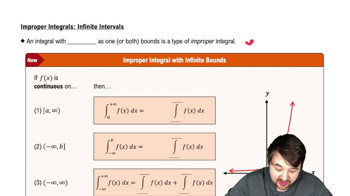
Improper Integrals: Infinite Intervals
관련 실천
교과서 질문

63. (Use of Tech) Normal distribution of heights

The heights of U.S. men are normally distributed with a mean of 69 in and a standard deviation of 3 in. This means that the fraction of men with a height between a and b (with a < b) inches is given by the integral

(1/(3√(2π))) ∫ₐᵇ e^(-((x-69)/3)²/2) dx.

What percentage of American men are between 66 and 72 inches tall? Use the method of your choice, and experiment with the number of subintervals until you obtain successive approximations that differ by less than 10⁻³.

74
views
교과서 질문

7-56. Trigonometric substitutions Evaluate the following integrals using trigonometric substitution.

51. ∫ x²/√(4 + x²) dx

50
views
교과서 질문

7-56. Trigonometric substitutions Evaluate the following integrals using trigonometric substitution.

33. ∫ √(x² - 9)/x dx, x > 3

73
views
교과서 질문

9–61. Trigonometric integrals Evaluate the following integrals.

16. ∫ sin²θ cos⁵θ dθ

132
views
교과서 질문

29-34. {Use of Tech} Comparing the Midpoint and Trapezoid Rules

Apply the Midpoint and Trapezoid Rules to the following integrals. Make a table similar to Table 8.5 showing the approximations and errors for n = 4, 8, 16, and 32. The exact values of the integrals are given for computing the error.

33. ∫(0 to π) sin x cos(3x) dx = 0

70
views
교과서 질문

76–83. Preliminary steps The following integrals require a preliminary step such as a change of variables before using the method of partial fractions. Evaluate these integrals.

82. ∫ [dx / (x√(1 + 2x))]

87
views