Ch. 8 - Integration Techniques
Briggs - Calculus: Early Transcendentals 3rd Edition
Briggs3rd EditionCalculus: Early TranscendentalsISBN: 9780136847243당신이 사용하는 게 아니라요?교과서 변경
8장, 문제 8.2.82e

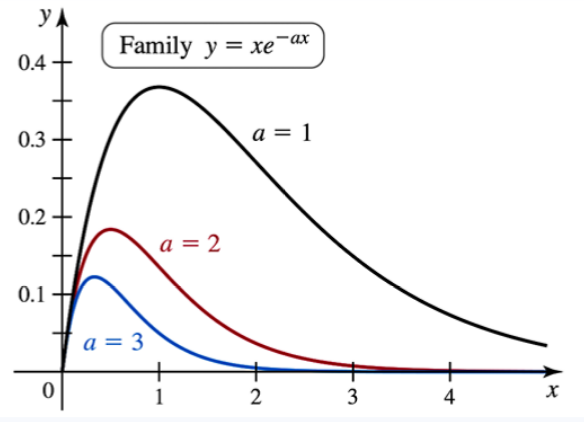
82. A family of exponentials The curves y = x * e^(-a * x) are shown in the figure for a = 1, 2, and 3.


Graph of y = x * e^(-a * x) showing curves for a = 1, 2, and 3, illustrating a family of exponential decay functions.


e. Does this pattern continue? Is it true that A(1, ln b) = a² * A(a, (ln b)/a)?

검증된 단계별 안내
1
First, understand the function given: \(y = x e^{-a x}\), where \(a\) is a parameter that changes the shape of the curve. The graph shows this function for \(a = 1, 2, 3\).
Next, identify what \(A(a, b)\) represents in the problem. Typically, \(A(a, b)\) might denote the value of the function or an area related to the function at specific points. Here, it likely means the value of the function \(y = x e^{-a x}\) evaluated at \(x = b\) for a given \(a\), so \(A(a, b) = b e^{-a b}\).
To check the given relation \(A(1, \ln b) = a^2 \cdot A(a, \frac{\ln b}{a})\), substitute the definitions: - Compute \(A(1, \ln b) = (\ln b) e^{-1 \cdot \ln b}\). - Compute \(A(a, \frac{\ln b}{a}) = \left(\frac{\ln b}{a}\right) e^{-a \cdot \frac{\ln b}{a}}\).
Simplify the exponentials using the property \(e^{\ln x} = x\) and \(e^{-\ln x} = \frac{1}{x}\): - \(e^{-\ln b} = \frac{1}{b}\), - \(e^{-a \cdot \frac{\ln b}{a}} = e^{-\ln b} = \frac{1}{b}\).
After simplification, compare both sides of the equation: - Left side: \(A(1, \ln b) = (\ln b) \cdot \frac{1}{b} = \frac{\ln b}{b}\), - Right side: \(a^2 \cdot \left( \frac{\ln b}{a} \cdot \frac{1}{b} \right) = a^2 \cdot \frac{\ln b}{a b} = a \cdot \frac{\ln b}{b}\). Since the left side is \(\frac{\ln b}{b}\) and the right side is \(a \cdot \frac{\ln b}{b}\), the equality holds only if \(a = 1\). Therefore, the pattern does not continue for all \(a\).

비슷한 문제에 대한 검증된 영상 답변:

이 영상 해법은 위 문제에 도움이 된다고 튜터들이 추천한 것입니다.
영상 길이:
4m

주요 개념

질문에 올바르게 답하기 위해 반드시 이해해야 하는 핵심 개념들은 다음과 같습니다.

Exponential Functions and Their Properties

Exponential functions involve variables in the exponent, such as e^(-ax). They model growth or decay processes, where the parameter 'a' controls the rate of decay. Understanding how changing 'a' affects the shape and behavior of the function is crucial for analyzing the family of curves y = x * e^(-ax).
추천 영상:
가이드 코스
06:21
Properties of Functions

Area Under a Curve and Definite Integrals

The area under a curve y = f(x) between two points is found using definite integrals. This concept is essential for interpreting A(a, b) as the integral of y = x * e^(-ax) from 0 to b. Calculating or relating these areas helps in verifying patterns or identities involving integrals of the family of functions.
추천 영상:
가이드 코스
05:43
Definition of the Definite Integral

Change of Variables in Integration

Change of variables (substitution) is a technique to simplify integrals by transforming the variable of integration. It is key to understanding the relationship A(1, ln b) = a² * A(a, (ln b)/a), as it involves scaling and shifting the integral limits and integrand to reveal underlying patterns or equivalences.
추천 영상:
가이드 코스
06:35
Changing Geometries