Ch. 8 - Integration Techniques
Briggs - Calculus: Early Transcendentals 3rd Edition
Briggs3rd EditionCalculus: Early TranscendentalsISBN: 9780136847243당신이 사용하는 게 아니라요?교과서 변경
8장, 문제 8.6.74

Evaluate the following integrals.
∫ e³ˣ/(eˣ - 1) dx

검증된 단계별 안내
1
Step 1: Recognize that the integral involves a fraction with exponential functions. To simplify, consider substituting a variable to make the integral more manageable. Let u = eˣ, which implies that du = eˣ dx.
Step 2: Rewrite the integral in terms of u. Since eˣ = u, the numerator becomes u³, and the denominator becomes u - 1. The dx term is replaced by du/u based on the substitution.
Step 3: The integral now becomes ∫ u³ / (u(u - 1)) du. Simplify the fraction to ∫ u² / (u - 1) du.
Step 4: To solve ∫ u² / (u - 1) du, consider polynomial long division or partial fraction decomposition to break the integrand into simpler terms. Perform the division or decomposition to express the integrand as a sum of simpler fractions.
Step 5: Integrate each term resulting from the decomposition or division separately. Use standard integration techniques, such as the natural logarithm for terms like 1/(u - 1) and power rule for polynomial terms. Finally, substitute back u = eˣ to express the solution in terms of x.

비슷한 문제에 대한 검증된 영상 답변:

이 영상 해법은 위 문제에 도움이 된다고 튜터들이 추천한 것입니다.
영상 길이:
4m
도움이 되었나요?

주요 개념

질문에 올바르게 답하기 위해 반드시 이해해야 하는 핵심 개념들은 다음과 같습니다.

Integration

Integration is a fundamental concept in calculus that involves finding the integral of a function, which represents the area under the curve of that function. It is the reverse process of differentiation and can be used to calculate quantities such as total distance, area, and volume. Understanding the techniques of integration, including substitution and integration by parts, is essential for solving integral problems.
추천 영상:
06:18
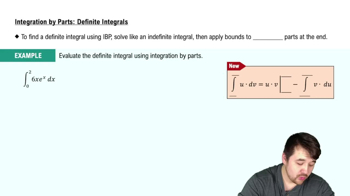
Integration by Parts for Definite Integrals

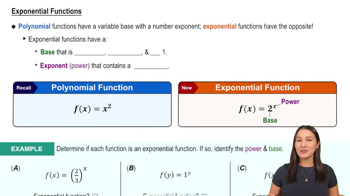
Exponential Functions

Exponential functions are mathematical functions of the form f(x) = a * e^(bx), where e is the base of natural logarithms, and a and b are constants. These functions grow rapidly and are characterized by their unique properties, such as the derivative of e^(x) being e^(x) itself. In the context of the given integral, recognizing the behavior of e^(3x) and e^(x) is crucial for simplifying the expression.
추천 영상:
6:13
Exponential Functions

Improper Integrals

Improper integrals are integrals that involve infinite limits or integrands that approach infinity within the interval of integration. They require special techniques to evaluate, often involving limits to define the integral properly. In the case of the integral ∫ e^(3x)/(e^x - 1) dx, understanding how to handle potential singularities or discontinuities in the integrand is vital for finding a valid solution.
추천 영상:
11:11
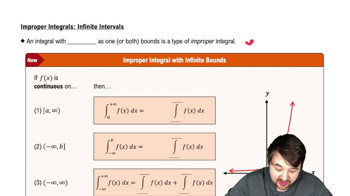
Improper Integrals: Infinite Intervals