
Ch. 9 - Differential Equations
Briggs - Calculus: Early Transcendentals 3rd Edition
Briggs3rd EditionCalculus: Early TranscendentalsISBN: 9780136847243당신이 사용하는 게 아니라요?교과서 변경
9장, 문제 9.2.16

12–16. Sketching direction fields Use the window [-2, 2] x [-2, 2] to sketch a direction field for the following equations. Then sketch the solution curve that corresponds to the given initial condition. A detailed direction field is not needed.
y(x) = sin y, y(−2) = 1/2

검증된 단계별 안내
1
Identify the differential equation given: \(\frac{dy}{dx} = \sin y\). This means the slope of the solution curve at any point \((x, y)\) depends only on the value of \(y\) at that point.
Set up the window for the direction field as \(x \in [-2, 2]\) and \(y \in [-2, 2]\). This defines the range of \(x\) and \(y\) values where you will plot the slope segments.
At various points \((x, y)\) in the window, calculate the slope \(\frac{dy}{dx} = \sin y\). Since the slope depends only on \(y\), for each horizontal line at a fixed \(y\), the slope will be constant.
Draw small line segments at each point with the slope \(\sin y\). For example, at \(y=0\), \(\sin 0 = 0\), so the slope is zero and the segments are horizontal. At \(y=\frac{\pi}{2}\) (approximately 1.57), \(\sin y = 1\), so the slope is 1, and so on.
To sketch the solution curve passing through the initial condition \(y(-2) = \frac{1}{2}\), start at the point \((-2, 0.5)\) on the graph and follow the direction indicated by the slope segments, moving from left to right, tracing a curve that aligns with the slopes.

비슷한 문제에 대한 검증된 영상 답변:

이 영상 해법은 위 문제에 도움이 된다고 튜터들이 추천한 것입니다.
영상 길이:
3m
도움이 되었나요?

주요 개념

질문에 올바르게 답하기 위해 반드시 이해해야 하는 핵심 개념들은 다음과 같습니다.

Direction Fields

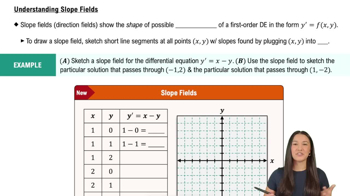
A direction field is a graphical representation of a first-order differential equation showing the slope of the solution curve at various points. Each small line segment indicates the slope y' = f(x, y) at that point, helping visualize the behavior of solutions without solving the equation explicitly.
추천 영상:
05:45
Understanding Slope Fields

Differential Equation y' = sin(y)

The given differential equation y' = sin(y) relates the slope of the solution curve to the sine of the dependent variable y. Understanding how sin(y) varies helps predict the slope patterns in the direction field, such as zero slopes at multiples of π and positive or negative slopes elsewhere.
추천 영상:
07:39
Classifying Differential Equations

Initial Condition and Solution Curves

An initial condition like y(−2) = 1/2 specifies a starting point on the direction field, allowing the sketching of a unique solution curve passing through that point. This curve follows the slope directions indicated by the field, illustrating how the solution evolves from the initial value.
추천 영상:
05:03
Initial Value Problems
관련 실천
교과서 질문

27–30. Newton’s Law of Cooling Solve the differential equation for Newton’s Law of Cooling to find the temperature function in the following cases. Then answer any additional questions.


A pot of boiling soup (100°C) is put in a cellar with a temperature of 10°C. After 30 minutes, the soup has cooled to 80°C. When will the temperature of the soup reach 30°C 

80
views
교과서 질문

25–28. Two steps of Euler’s method For the following initial value problems, compute the first two approximations u1 and u2 given by Euler’s method using the given time step.


y′(t) = 2−y, y(0) = 1; Δt = 0.1

97
views
교과서 질문

Direction fields Consider the direction field for the equation y′=y(2−y) shown in the figure and initial conditions of the form y(0)=A.

d. For what values of A are the corresponding solutions decreasing, for t≥0

71
views
교과서 질문

What are the assumptions underlying the predator-prey model discussed in this section?

96
views
교과서 질문

7–16. Verifying general solutions Verify that the given function is a solution of the differential equation that follows it. Assume C, C1, C2 and C3 are arbitrary constants.

u(t) = C₁t⁵ + C₂t⁻⁴ - t³; t²u''(t) - 20u(t) = 14t³

62
views
교과서 질문

39–42. Special equations A special class of first-order linear equations have the form a(t)y'(t)+a'(t)y(t)=f(t), where a and f are given functions of t. Notice that the left side of this equation can be written as the derivative of a product, so the equation has the form

a(t)y'(t) + a'(t)y(t) = d/dt (a(t)y(t)) = f(t). 

Therefore, the equation can be solved by integrating both sides with respect to t. Use this idea to solve the following initial value problems. 


t³y′(t) + 3t²y = (1 + t)/t, y(1) = 6

71
views