
Ch. 9 - Differential Equations
Briggs - Calculus: Early Transcendentals 3rd Edition
Briggs3rd EditionCalculus: Early TranscendentalsISBN: 9780136847243당신이 사용하는 게 아니라요?교과서 변경
9장, 문제 9.2.24

21–24. Logistic equations Consider the following logistic equations. In each case, sketch the direction field, draw the solution curve for each initial condition, and find the equilibrium solutions. A detailed direction field is not needed. Assume t ≥ 0 and tP ≥ 0.
P′(t) = 0.05P − 0.001P²; P(0) = 10, P(0) = 40, P(0) = 80

검증된 단계별 안내
1
Identify the given differential equation: \(P\'(t) = 0.05P - 0.001P^{2}\). This is a logistic differential equation modeling population growth with a carrying capacity.
Find the equilibrium solutions by setting the derivative equal to zero: \(0 = 0.05P - 0.001P^{2}\). Solve for \(P\) to find the constant solutions where the population does not change.
Rewrite the equation in the standard logistic form: \(P\'(t) = rP\left(1 - \frac{P}{K}\right)\), where \(r\) is the growth rate and \(K\) is the carrying capacity. Identify \(r\) and \(K\) from the given equation.
Sketch the direction field by analyzing the sign of \(P\'(t)\) for values of \(P\) less than, equal to, and greater than the equilibrium points. This will show whether the population is increasing or decreasing in those regions.
For each initial condition \(P(0) = 10\), \(P(0) = 40\), and \(P(0) = 80\), draw the qualitative solution curves on the direction field, showing how the population evolves over time toward the equilibrium solutions.

비슷한 문제에 대한 검증된 영상 답변:

이 영상 해법은 위 문제에 도움이 된다고 튜터들이 추천한 것입니다.
영상 길이:
4m
도움이 되었나요?

주요 개념

질문에 올바르게 답하기 위해 반드시 이해해야 하는 핵심 개념들은 다음과 같습니다.

Logistic Differential Equation

A logistic differential equation models population growth with a carrying capacity, combining exponential growth and a limiting factor. It has the form P' = rP(1 - P/K), where r is the growth rate and K is the carrying capacity. This equation captures how growth slows as the population approaches K.
추천 영상:
07:39
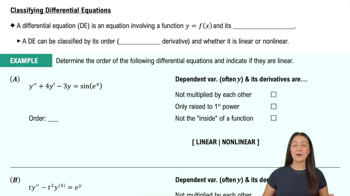
Classifying Differential Equations

Equilibrium Solutions

Equilibrium solutions occur where the derivative of the function is zero, meaning the population does not change over time. For logistic equations, these are found by setting P' = 0 and solving for P. Equilibria indicate stable or unstable population levels depending on the system dynamics.
추천 영상:
04:00
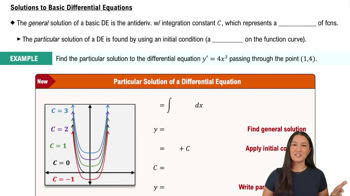
Solutions to Basic Differential Equations

Direction Fields and Solution Curves

Direction fields graphically represent the slope of solutions at various points, helping visualize the behavior of differential equations. Solution curves are drawn following these slopes from given initial conditions, showing how the population evolves over time. They illustrate stability and long-term trends.
추천 영상:
05:45
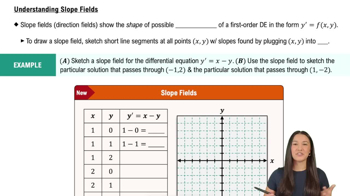
Understanding Slope Fields
관련 실천
교과서 질문

33–38. {Use of Tech} Solutions in implicit form Solve the following initial value problems and leave the solution in implicit form. Use graphing software to plot the solution. If the implicit solution describes more than one function, be sure to indicate which function corresponds to the solution of the initial value problem.

z(x) = (z² + 4)/(x² + 16), z(4) = 2

43
views
교과서 질문

33–38. {Use of Tech} Solutions in implicit form Solve the following initial value problems and leave the solution in implicit form. Use graphing software to plot the solution. If the implicit solution describes more than one function, be sure to indicate which function corresponds to the solution of the initial value problem.

y'(t) = 2t²/(y² − 1), y(0) = 0

41
views
교과서 질문

5–10. First-order linear equations Find the general solution of the following equations.


y'(x) = −y + 2

64
views
교과서 질문

21–24. Logistic equations Consider the following logistic equations. In each case, sketch the direction field, draw the solution curve for each initial condition, and find the equilibrium solutions. A detailed direction field is not needed. Assume t ≥ 0 and tP ≥ 0.

P′(t) = 0.05P(1−P/800); P(0) = 100, P(0) = 400, P(0) = 700

57
views
교과서 질문

Consider the differential equation y'(t) = t² - 3y² and the solution curve that passes through the point (3, 1). What is the slope of the curve at (3, 1)?

53
views
교과서 질문

5–16. Solving separable equations Find the general solution of the following equations. Express the solution explicitly as a function of the independent variable.

e⁴ᵗy'(t) = 5

64
views