
Ch. 9 - Differential Equations
Briggs - Calculus: Early Transcendentals 3rd Edition
Briggs3rd EditionCalculus: Early TranscendentalsISBN: 9780136847243당신이 사용하는 게 아니라요?교과서 변경
9장, 문제 9.1.21

21–32. Finding general solutions Find the general solution of each differential equation. Use C,C1,C2... to denote arbitrary constants.
y'(t) = 3 + e⁻²ᵗ

검증된 단계별 안내
1
Recognize that the given differential equation is a first-order ordinary differential equation of the form \(y'(t) = f(t)\), where \(f(t) = 3 + e^{-2t}\).
To find the general solution, integrate both sides with respect to \(t\): \(\int y'(t) \, dt = \int (3 + e^{-2t}) \, dt\).
Split the integral on the right side into two separate integrals: \(\int 3 \, dt + \int e^{-2t} \, dt\).
Integrate each term: the integral of \(3\) with respect to \(t\) is \$3t\(, and the integral of \)e^{-2t}\( with respect to \)t$ is \(-\frac{1}{2} e^{-2t}\) (using substitution or recognizing the exponential integral).
Combine the results and add the arbitrary constant of integration \(C\) to write the general solution: \(y(t) = 3t - \frac{1}{2} e^{-2t} + C\).

비슷한 문제에 대한 검증된 영상 답변:

이 영상 해법은 위 문제에 도움이 된다고 튜터들이 추천한 것입니다.
영상 길이:
1m
도움이 되었나요?

주요 개념

질문에 올바르게 답하기 위해 반드시 이해해야 하는 핵심 개념들은 다음과 같습니다.

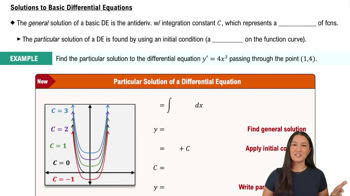
General Solution of a Differential Equation

The general solution of a differential equation includes all possible solutions and typically contains arbitrary constants. It represents the family of functions that satisfy the equation, capturing both particular and homogeneous parts.
추천 영상:
04:00
Solutions to Basic Differential Equations

Integration of Functions

Solving first-order differential equations often involves integrating the right-hand side with respect to the independent variable. Integration reverses differentiation and helps find the original function from its derivative.
추천 영상:
05:11
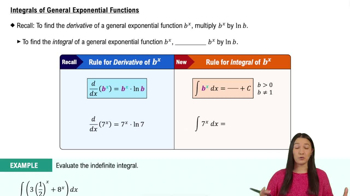
Integrals of General Exponential Functions

Exponential Functions and Their Integrals

Exponential functions like e^(-2t) have specific integral formulas. For example, ∫e^(kt) dt = (1/k)e^(kt) + C, where k is a constant. Recognizing and integrating these correctly is essential for solving differential equations involving exponentials.
추천 영상:
05:11
Integrals of General Exponential Functions