
Ch. 9 - Differential Equations
Briggs - Calculus: Early Transcendentals 3rd Edition
Briggs3rd EditionCalculus: Early TranscendentalsISBN: 9780136847243당신이 사용하는 게 아니라요?교과서 변경
9장, 문제 9.1.24

21–32. Finding general solutions Find the general solution of each differential equation. Use C,C1,C2... to denote arbitrary constants.
p'(x) = 16/x⁹ - 5 + 14x⁶

검증된 단계별 안내
1
Identify the given differential equation: \(p'(x) = \frac{16}{x^{9}} - 5 + 14x^{6}\). This means the derivative of \(p(x)\) with respect to \(x\) is given by this expression.
To find the general solution \(p(x)\), integrate both sides of the equation with respect to \(x\): \(p(x) = \int \left( \frac{16}{x^{9}} - 5 + 14x^{6} \right) \, dx\).
Rewrite the integrand to make integration easier: \(\frac{16}{x^{9}} = 16x^{-9}\), so the integral becomes \(\int \left( 16x^{-9} - 5 + 14x^{6} \right) \, dx\).
Integrate each term separately using the power rule for integration: \(\int x^{n} \, dx = \frac{x^{n+1}}{n+1} + C\), where \(n \neq -1\).
After integrating each term, combine the results and add the arbitrary constant of integration \(C\) to express the general solution \(p(x)\).

비슷한 문제에 대한 검증된 영상 답변:

이 영상 해법은 위 문제에 도움이 된다고 튜터들이 추천한 것입니다.
영상 길이:
2m
도움이 되었나요?

주요 개념

질문에 올바르게 답하기 위해 반드시 이해해야 하는 핵심 개념들은 다음과 같습니다.

General Solution of a Differential Equation

The general solution of a differential equation includes all possible solutions and contains arbitrary constants representing the family of curves satisfying the equation. For first-order equations, integrating the derivative function yields the general solution plus a constant of integration.
추천 영상:
04:00
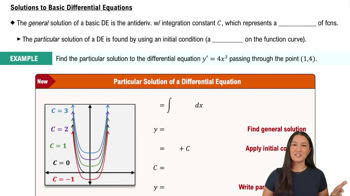
Solutions to Basic Differential Equations

Integration of Functions

Integration is the reverse process of differentiation and is used to find the original function from its derivative. To solve p'(x), integrate each term separately with respect to x, applying power rule integration and adding an arbitrary constant.
추천 영상:
05:11
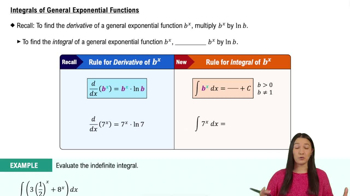
Integrals of General Exponential Functions

Power Rule for Integration

The power rule states that ∫x^n dx = (x^(n+1))/(n+1) + C for any real number n ≠ -1. This rule is essential for integrating terms like 16/x⁹ and 14x⁶ by rewriting negative exponents and applying the formula correctly.
추천 영상:
04:04
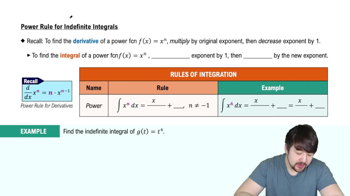
Power Rule for Indefinite Integrals
관련 실천
교과서 질문

33–38. {Use of Tech} Solutions in implicit form Solve the following initial value problems and leave the solution in implicit form. Use graphing software to plot the solution. If the implicit solution describes more than one function, be sure to indicate which function corresponds to the solution of the initial value problem.

z(x) = (z² + 4)/(x² + 16), z(4) = 2

43
views
교과서 질문

17–32. Solving initial value problems Determine whether the following equations are separable. If so, solve the initial value problem.

y'(t) = eᵗʸ, y(0) = 1

51
views
교과서 질문

Explain why the graph of the solution to the initial value problem y'(t) = t²/(1 - t), y(-1) = ln 2 cannot cross the line t = 1.

53
views
교과서 질문

5–16. Solving separable equations Find the general solution of the following equations. Express the solution explicitly as a function of the independent variable.

(t² + 1)³yy'(t) = t(y² + 4)

56
views
교과서 질문

33–38. {Use of Tech} Solutions in implicit form Solve the following initial value problems and leave the solution in implicit form. Use graphing software to plot the solution. If the implicit solution describes more than one function, be sure to indicate which function corresponds to the solution of the initial value problem.

y'(t) = 2t²/(y² − 1), y(0) = 0

41
views
교과서 질문

Case 2 of the general solution Solve the equation y′(t) = ky + b in the case that ky + b < 0 and verify that the general solution is y(t) = Ceᵏᵗ − b/k.

63
views