
Ch. 9 - Differential Equations
Briggs - Calculus: Early Transcendentals 3rd Edition
Briggs3rd EditionCalculus: Early TranscendentalsISBN: 9780136847243당신이 사용하는 게 아니라요?교과서 변경
9장, 문제 9.4.26

23–26. Loan problems The following initial value problems model the payoff of a loan. In each case, solve the initial value problem, for t≥0 graph the solution, and determine the first month in which the loan balance is zero.


B′(t) = 0.004B − 800, B(0) = 40,000

검증된 단계별 안내
1
Identify the type of differential equation given: \( B'(t) = 0.004B - 800 \). This is a first-order linear ordinary differential equation.
Rewrite the equation in standard linear form: \( B'(t) - 0.004B = -800 \). This will help us apply the integrating factor method.
Calculate the integrating factor \( \mu(t) \) using the formula \( \mu(t) = e^{\int -0.004 \, dt} = e^{-0.004t} \).
Multiply both sides of the differential equation by the integrating factor \( e^{-0.004t} \) to get \( e^{-0.004t} B'(t) - 0.004 e^{-0.004t} B = -800 e^{-0.004t} \). Recognize that the left side is the derivative of \( e^{-0.004t} B(t) \).
Integrate both sides with respect to \( t \) to find \( e^{-0.004t} B(t) \), then solve for \( B(t) \). Use the initial condition \( B(0) = 40,000 \) to find the constant of integration. Finally, analyze \( B(t) \) to determine when the loan balance reaches zero by solving \( B(t) = 0 \) for \( t \).

비슷한 문제에 대한 검증된 영상 답변:

이 영상 해법은 위 문제에 도움이 된다고 튜터들이 추천한 것입니다.
영상 길이:
6m
도움이 되었나요?

주요 개념

질문에 올바르게 답하기 위해 반드시 이해해야 하는 핵심 개념들은 다음과 같습니다.

First-Order Linear Differential Equations

This type of differential equation has the form B'(t) + p(t)B = q(t). Solving it involves finding an integrating factor to simplify the equation and then integrating both sides. It models processes where the rate of change depends linearly on the current value, such as loan balances with interest and payments.
추천 영상:
07:39
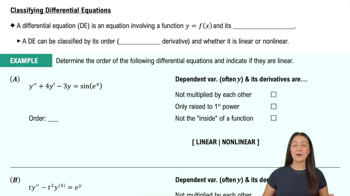
Classifying Differential Equations

Initial Value Problems (IVP)

An IVP specifies the value of the unknown function at a particular point, here B(0) = 40,000. This condition allows us to find the unique solution to the differential equation that fits the initial state, ensuring the solution models the specific loan scenario accurately.
추천 영상:
05:03
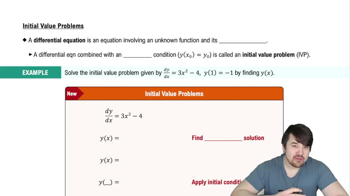
Initial Value Problems

Interpreting and Graphing Solutions

After solving the differential equation, graphing the solution B(t) helps visualize how the loan balance changes over time. Determining when B(t) = 0 identifies the payoff time, which is crucial for understanding the loan's duration and financial planning.
추천 영상:
06:15
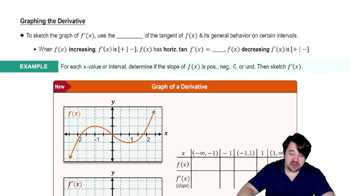
Graphing The Derivative
관련 실천
교과서 질문

39–42. Special equations A special class of first-order linear equations have the form a(t)y'(t)+a'(t)y(t)=f(t), where a and f are given functions of t. Notice that the left side of this equation can be written as the derivative of a product, so the equation has the form

a(t)y'(t) + a'(t)y(t) = d/dt (a(t)y(t)) = f(t). 

Therefore, the equation can be solved by integrating both sides with respect to t. Use this idea to solve the following initial value problems. 


(t² + 1)y′(t) + 2ty = 3t², y(2) = 8

48
views
교과서 질문

Does the function y(t) = 2t satisfy the differential equation y'''(t) + y'(t) = 2?

59
views
교과서 질문

11–16. Initial value problems Solve the following initial value problems.


y'(x) = −y + 2, y(0) = −2

83
views
교과서 질문

Stability of Euler's method Consider the initial value problem y′(t) = −ay, y(0) = 1 where a > 0; it has the exact solution y(t) = e⁻ᵃᵗ, which is a decreasing function.


a. Show that Euler's method applied to this problem with time step h can be written u₀ = 1, uₖ₊₁ = (1 − ah)uₖ for k = 0, 1, 2, ...


b. Show by substitution that uₖ = (1 − ah)ᵏ is a solution of the equations in part (a), for k = 0, 1, 2, ...

67
views
교과서 질문

Explain how to solve a separable differential equation of the form

g(t)y'(y) = h(t)

78
views
교과서 질문

17–32. Solving initial value problems Determine whether the following equations are separable. If so, solve the initial value problem.

y'(t) = yeᵗ, y(0) = −1

75
views