
Ch. 9 - Differential Equations
Briggs - Calculus: Early Transcendentals 3rd Edition
Briggs3rd EditionCalculus: Early TranscendentalsISBN: 9780136847243당신이 사용하는 게 아니라요?교과서 변경
9장, 문제 9.5.26a

23–26. Stirred tank reactions For each of the following stirred tank reactions, carry out the following analysis.
a. Write an initial value problem for the mass of the substance.


A one-million-liter pond is contaminated by a chemical pollutant with a concentration of 20 g/L. The source of the pollutant is removed, and pure water is allowed to flow into the pond at a rate of 1200 L/hr. Assuming the pond is thoroughly mixed and drained at a rate of 1200 L/hr, how long does it take to reduce the concentration of the solution in the pond to 10% of the initial value?

검증된 단계별 안내
1
Define the variable \(m(t)\) as the mass of the pollutant in the pond at time \(t\) (in hours). Since the pond volume is constant at 1,000,000 liters, the concentration at time \(t\) is \(c(t) = \frac{m(t)}{1,000,000}\) grams per liter.
Set up the initial condition: at time \(t=0\), the mass of pollutant is \(m(0) = 20 \text{ g/L} \times 1,000,000 \text{ L} = 20,000,000\) grams.
Write the rate of change of mass \(\frac{dm}{dt}\) considering the inflow and outflow. Since pure water flows in, no pollutant enters, so the inflow term is zero. The outflow removes pollutant at a rate proportional to the concentration and the outflow rate: \(\frac{dm}{dt} = - (\text{outflow rate}) \times c(t) = -1200 \times \frac{m(t)}{1,000,000}\).
Formulate the initial value problem (IVP) as the differential equation: \(\frac{dm}{dt} = -\frac{1200}{1,000,000} m(t)\) with initial condition \(m(0) = 20,000,000\).
To find the time \(t\) when the concentration is 10% of the initial value, set \(c(t) = 0.1 \times 20 = 2\) g/L, which means \(m(t) = 2 \times 1,000,000 = 2,000,000\) grams. Solve the IVP for \(m(t)\) and then solve for \(t\) when \(m(t) = 2,000,000\).

비슷한 문제에 대한 검증된 영상 답변:

이 영상 해법은 위 문제에 도움이 된다고 튜터들이 추천한 것입니다.
영상 길이:
4m

주요 개념

질문에 올바르게 답하기 위해 반드시 이해해야 하는 핵심 개념들은 다음과 같습니다.

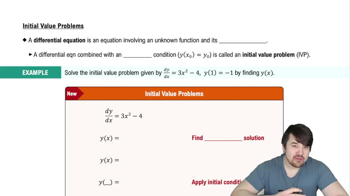
Formulating Initial Value Problems (IVPs)

An initial value problem involves setting up a differential equation that models the rate of change of a quantity along with an initial condition. In this context, it means expressing how the mass of the pollutant changes over time based on inflow, outflow, and mixing, starting from the known initial mass.
추천 영상:
가이드 코스
05:03
Initial Value Problems

Mixing and Flow in Stirred Tank Models

A stirred tank model assumes the contents are perfectly mixed, so the concentration is uniform throughout. The inflow and outflow rates affect the concentration by diluting or removing the substance, and the volume remains constant if inflow equals outflow, simplifying the mass balance.
추천 영상:
09:29
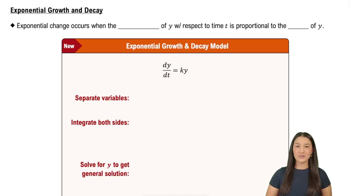
Exponential Growth & Decay

Solving First-Order Linear Differential Equations

The mass or concentration change in the pond can be described by a first-order linear differential equation. Solving this equation involves integrating to find the concentration as a function of time, which allows determining how long it takes for the concentration to reach a specified fraction of its initial value.
추천 영상:
06:06
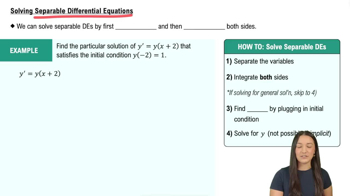
Solving Separable Differential Equations
관련 실천
교과서 질문

38–43. Equilibrium solutions A differential equation of the form y′(t)=f(y) is said to be autonomous (the function f depends only on y). The constant function y=y0 is an equilibrium solution of the equation provided f(y0)=0 (because then y'(t)=0 and the solution remains constant for all t). Note that equilibrium solutions correspond to horizontal lines in the direction field. Note also that for autonomous equations, the direction field is independent of t. Carry out the following analysis on the given equations.

a. Find the equilibrium solutions. 


y′(t) = y(y - 3)(y + 2)

78
views
교과서 질문

{Use of Tech} Endowment model An endowment is an investment account in which the balance ideally remains constant and withdrawals are made on the interest earned by the account. Such an account may be modeled by the initial value problem B′(t)=rB−m, for t≥0, with B(0)=B0. The constant r>0 reflects the annual interest rate, m>0 is the annual rate of withdrawal, B0 is the initial balance in the account, and t is measured in years.


a. Solve the initial value problem with r=0.05, m=\$1000/year, and B0=\$15,000 Does the balance in the account increase or decrease?

32
views
교과서 질문

Direction field analysis Consider the first-order initial value problem y'(t)=ay+b,y(0)=A for t≥0 where a, b, and A are real numbers.

a. Explain why y=−b/a is an equilibrium solution and corresponds to a horizontal line in the direction field.

57
views
교과서 질문

52-56. In this section, several models are presented and the solution of the associated differential equation is given. Later in the chapter, we present methods for solving these differential equations.


where P(t) is the population, for t ≥ 0, and r > 0 and K > 0 are given constants.


a. Verify by substitution that the general solution of the equation is P(t) = K/(1 + Ce⁻ʳᵗ), where C is an arbitrary constant.

57
views
교과서 질문

{Use of Tech} Chemical rate equations Let y(t) be t he concentration of a substance in a chemical reaction (typical units are moles/liter). The change in the concentration, under appropriate conditions, is modeled by the equation dy/dt=-ky^n for t≥0, where k>0 is a rate constant and the positive integer n is the order of the reaction.

b. Solve the initial value problem for a second-order reaction (n=2) assuming y(0)=y0.

42
views
교과서 질문

Solving Bernoulli equations Use the method outlined in Exercise 43 to solve the following Bernoulli equations.


a. y′(t) + y = 2y²

125
views