Ch. 9 - Differential Equations
Briggs - Calculus: Early Transcendentals 3rd Edition
Briggs3rd EditionCalculus: Early TranscendentalsISBN: 9780136847243당신이 사용하는 게 아니라요?교과서 변경
9장, 문제 9.1.46

45–46. Harvesting problems Consider the harvesting problem in Example 6.
If r = 0.05 and H = 500, for what values of p₀ is the amount of the resource decreasing? For what value of p₀ is the amount of the resource constant? If p₀ = 9000, when does the resource vanish?

검증된 단계별 안내
1
Recall the harvesting model differential equation from Example 6, which is typically of the form: \[\frac{dp}{dt} = rp - H,\] where \(p(t)\) is the amount of the resource at time \(t\), \(r\) is the growth rate, and \(H\) is the harvesting rate.
To determine when the amount of the resource is decreasing, analyze the sign of \[\frac{dp}{dt} = rp - H.\] The resource decreases when \[\frac{dp}{dt} < 0,\] which means \[rp - H < 0.\] Solve this inequality for \(p\) to find the values of \(p_0\) (initial amount) where the resource decreases.
To find when the amount of the resource is constant, set \[\frac{dp}{dt} = 0,\] which gives \[rp - H = 0.\] Solve for \(p\) to find the equilibrium value of \(p_0\) where the resource neither increases nor decreases.
Given \(p_0 = 9000\(, solve the differential equation \[\frac{dp}{dt} = rp - H\] with initial condition \)p(0) = 9000\) to find \(p(t)\). This is a first-order linear differential equation and can be solved using an integrating factor or separation of variables.
Once you have the explicit solution \(p(t)\), determine the time \(t\( when the resource vanishes by solving \[p(t) = 0\] for \)t\). This will give the time at which the resource is completely depleted.

비슷한 문제에 대한 검증된 영상 답변:

이 영상 해법은 위 문제에 도움이 된다고 튜터들이 추천한 것입니다.
영상 길이:
5m
도움이 되었나요?

주요 개념

질문에 올바르게 답하기 위해 반드시 이해해야 하는 핵심 개념들은 다음과 같습니다.

Differential Equations in Population Dynamics

Differential equations model how populations change over time, incorporating growth and harvesting rates. In harvesting problems, the rate of change of the resource depends on natural growth minus the harvesting amount, allowing prediction of resource levels at any time.
추천 영상:
07:39
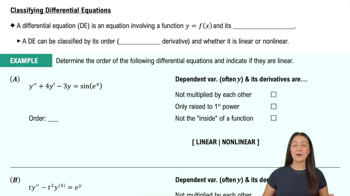
Classifying Differential Equations

Equilibrium Points and Stability

An equilibrium point occurs when the population remains constant over time, meaning growth equals harvesting. Determining the equilibrium helps identify values of the initial population where the resource neither grows nor declines, crucial for sustainable harvesting.
추천 영상:
04:50
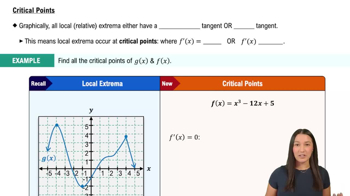
Critical Points

Time to Extinction in Resource Models

Time to extinction refers to when the resource population reaches zero under given harvesting and growth rates. Solving the differential equation with initial conditions allows calculation of when the resource vanishes, important for managing resource depletion.
추천 영상:
09:29
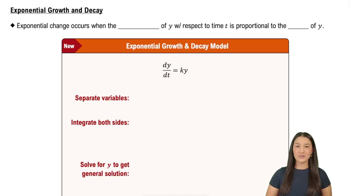
Exponential Growth & Decay
관련 실천
교과서 질문

33–42. Solving initial value problems Solve the following initial value problems.

p'(x) = 2/(x² + x), p(1) = 0

48
views

교과서 질문

11–16. Initial value problems Solve the following initial value problems.


y'(t) − 3y = 12, y(1) = 4

46
views
교과서 질문

17–18. {Use of Tech} Designing logistic functions Use the method of Example 1 to find a logistic function that describes the following populations. Graph the population function.


The population increases from 50 to 60 in the first month and eventually levels off at 150.

64
views
교과서 질문

Stability of Euler's method Consider the initial value problem y′(t) = −ay, y(0) = 1 where a > 0; it has the exact solution y(t) = e⁻ᵃᵗ, which is a decreasing function.


a. Show that Euler's method applied to this problem with time step h can be written u₀ = 1, uₖ₊₁ = (1 − ah)uₖ for k = 0, 1, 2, ...


b. Show by substitution that uₖ = (1 − ah)ᵏ is a solution of the equations in part (a), for k = 0, 1, 2, ...

67
views
교과서 질문

Explain how to solve a separable differential equation of the form

g(t)y'(y) = h(t)

78
views
교과서 질문

27–30. Newton’s Law of Cooling Solve the differential equation for Newton’s Law of Cooling to find the temperature function in the following cases. Then answer any additional questions.


An iron rod is removed from a blacksmith’s forge at a temperature of 900°C . Assume k=0.02 and the rod cools in a room with a temperature of 30°C When does the temperature of the rod reach 100°C? 

198
views