
Ch. 9 - Differential Equations
Briggs - Calculus: Early Transcendentals 3rd Edition
Briggs3rd EditionCalculus: Early TranscendentalsISBN: 9780136847243당신이 사용하는 게 아니라요?교과서 변경
9장, 문제 9.5.36a

A physiological model A common assumption in modeling drug assimilation is that the blood volume in a person is a single compartment that behaves like a stirred tank. Suppose the blood volume is a four-liter tank that initially has a zero concentration of a particular drug. At time t = 0, an intravenous line is inserted into a vein (into the tank) that carries a drug solution with a concentration of 500 mg/L. The inflow rate is 0.06 L/min. Assume the drug is quickly mixed thoroughly in the blood and that the volume of blood remains constant.
a. Write an initial value problem that models the mass of the drug in the blood, for t ≥ 0.

검증된 단계별 안내
1
Define the variable: let \(M(t)\) represent the mass of the drug (in mg) in the blood at time \(t\) (in minutes).
Identify the rate of change of the mass of the drug in the blood, \(\frac{dM}{dt}\), which depends on the inflow and outflow of the drug.
Since the blood volume is constant at 4 liters and the drug is well mixed, the concentration of the drug in the blood at time \(t\) is \(\frac{M(t)}{4}\) mg/L.
The inflow rate of the drug mass is the product of the inflow volume rate and the concentration of the incoming drug solution: \(0.06 \text{ L/min} \times 500 \text{ mg/L} = 30\) mg/min.
The outflow rate of the drug mass is the product of the outflow volume rate (same as inflow, 0.06 L/min) and the concentration in the blood: \(0.06 \times \frac{M(t)}{4} = 0.015 M(t)\) mg/min. Therefore, the differential equation modeling the mass is: \(\frac{dM}{dt} = 30 - 0.015 M(t)\), with the initial condition \(M(0) = 0\) since initially there is no drug in the blood.

비슷한 문제에 대한 검증된 영상 답변:

이 영상 해법은 위 문제에 도움이 된다고 튜터들이 추천한 것입니다.
영상 길이:
6m
도움이 되었나요?

주요 개념

질문에 올바르게 답하기 위해 반드시 이해해야 하는 핵심 개념들은 다음과 같습니다.

Formulating Differential Equations from Physical Models

This involves translating a real-world scenario into a mathematical equation that describes how a quantity changes over time. In this problem, the rate of change of the drug mass in the blood depends on the inflow concentration and rate, and the mixing assumption allows us to model it with a first-order differential equation.
추천 영상:
07:39
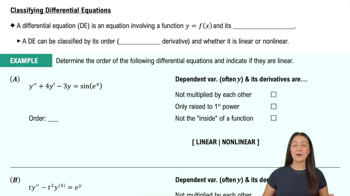
Classifying Differential Equations

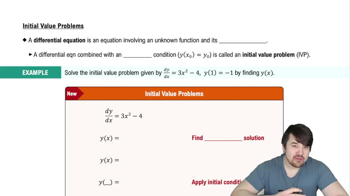
Initial Value Problems (IVP)

An initial value problem consists of a differential equation paired with an initial condition that specifies the state of the system at the start time. Here, the initial drug mass is zero at time t = 0, which helps uniquely determine the solution to the differential equation modeling the drug concentration.
추천 영상:
가이드 코스
05:03
Initial Value Problems

Conservation of Mass and Mixing Assumptions

The conservation of mass principle states that the change in drug mass in the blood equals the mass entering minus the mass leaving. Assuming the blood is a well-mixed compartment means the drug concentration is uniform throughout, simplifying the model to depend only on total mass and inflow parameters.
추천 영상:
가이드 코스
09:32
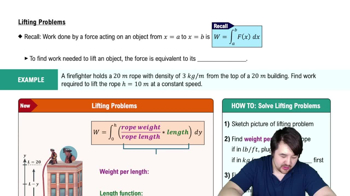
Lifting Problems
관련 실천
교과서 질문

{Use of Tech} Logistic equation for spread of rumors Sociologists model the spread of rumors using logistic equations. The key assumption is that at any given time, a fraction y of the population, where 0≤y≤1, knows the rumor, while the remaining fraction 1−y does not. Furthermore, the rumor spreads by interactions between those who know the rumor and those who do not. The number of such interactions is proportional to y1−y. Therefore, the equation that describes the spread of the rumor is y′(t)=ky(1−y), for t≥0 where k is a positive real number and t is measured in weeks. The number of people who initially know the rumor is y(0)=y0, where 0≤y0≤1. 

a. Solve this initial value problem and give the solution in terms of k and y0.

63
views
교과서 질문

{Use of Tech} Analytical solution of the predator-prey equations The solution of the predator-prey equations

X'(t) = -ax + bxy,y’(t) = cy - dxy

can be viewed as parametric equations that describe the solution curves. Assume a, b, c, and d are positive constants and consider solutions in the first quadrant.


a. Recalling that dy/dx = y(t)/x′(t), divide the first equation by the second equation to obtain a separable differential equation in terms of x and y.

49
views
교과서 질문

33–36. {Use of Tech} Computing Euler approximations Use a calculator or computer program to carry out the following steps.

a. Approximate the value of y(T) using Euler’s method with the given time step on the interval [0,T].


y′(t) = t/y, y(0) = 4; Δt = 0.1, T = 2; y(t) = √(t² + 16)

43
views
교과서 질문

46–48. Analyzing models The following models were discussed in Section 9.1 and reappear in later sections of this chapter. In each case, carry out the indicated analysis using direction fields.

Drug infusion The delivery of a drug (such as an antibiotic) through an intravenous line may be modeled by the differential equation m′(t)+km(t)=I, where m(t) is the mass of the drug in the blood at time t≥0, K is a constant that describes the rate at which the drug is absorbed, and I is the infusion rate. Let I=10mg/hr and k=0.05 hr^−1.

a. Draw the direction field, for 0≤t≤100, 0≤y≤600.

42
views
교과서 질문

Consider the differential equation y'(t)+9y(t)=10.

a. How many arbitrary constants appear in the general solution of the differential equation?

56
views
교과서 질문

38–43. Equilibrium solutions A differential equation of the form y′(t)=f(y) is said to be autonomous (the function f depends only on y). The constant function y=y0 is an equilibrium solution of the equation provided f(y0)=0 (because then y'(t)=0 and the solution remains constant for all t). Note that equilibrium solutions correspond to horizontal lines in the direction field. Note also that for autonomous equations, the direction field is independent of t. Carry out the following analysis on the given equations.

a. Find the equilibrium solutions. 


y′(t) = 6 - 2y

96
views