
Ch. 9 - Differential Equations
Briggs - Calculus: Early Transcendentals 3rd Edition
Briggs3rd EditionCalculus: Early TranscendentalsISBN: 9780136847243당신이 사용하는 게 아니라요?교과서 변경
9장, 문제 9.1.50d

A second-order equation Consider the differential equation y''(t) - k²y(t) = 0 where k > 0 is a real number.


d. For a positive real number k, verify that the general solution of the equation may also be expressed in the form y(t) = C₁cosh(kt) + C₂sinh(kt), where cosh and sinh are the hyperbolic cosine and hyperbolic sine, respectively (Section 7.3).

검증된 단계별 안내
1
Start with the given differential equation: \(y''(t) - k^{2} y(t) = 0\), where \(k > 0\).
Write the characteristic equation associated with the differential equation: \(r^{2} - k^{2} = 0\).
Solve the characteristic equation for \(r\): \(r^{2} = k^{2}\), so \(r = \pm k\).
Write the general solution using the exponential functions corresponding to the roots: \(y(t) = C_{1} e^{kt} + C_{2} e^{-kt}\).
Recall the definitions of hyperbolic cosine and sine: \(\cosh(kt) = \frac{e^{kt} + e^{-kt}}{2}\) and \(\sinh(kt) = \frac{e^{kt} - e^{-kt}}{2}\). Use these to rewrite the general solution as \(y(t) = A \cosh(kt) + B \sinh(kt)\), where \(A\) and \(B\) are constants related to \(C_{1}\) and \(C_{2}\).

비슷한 문제에 대한 검증된 영상 답변:

이 영상 해법은 위 문제에 도움이 된다고 튜터들이 추천한 것입니다.
영상 길이:
3m
도움이 되었나요?

주요 개념

질문에 올바르게 답하기 위해 반드시 이해해야 하는 핵심 개념들은 다음과 같습니다.

Second-Order Linear Differential Equations

These are differential equations involving the second derivative of a function and can often be solved by finding characteristic equations. Solutions typically involve exponential, trigonometric, or hyperbolic functions depending on the nature of the roots of the characteristic equation.
추천 영상:
07:39
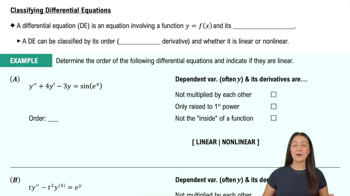
Classifying Differential Equations

Characteristic Equation and Its Roots

For the equation y'' - k²y = 0, the characteristic equation is r² - k² = 0, yielding roots r = ±k. These roots determine the form of the general solution, which can be expressed using exponentials or hyperbolic functions when roots are real and distinct.
추천 영상:

Hyperbolic Functions (cosh and sinh)

Hyperbolic cosine and sine, defined as cosh(t) = (e^t + e^{-t})/2 and sinh(t) = (e^t - e^{-t})/2, provide an alternative way to express solutions of differential equations with real roots. They are especially useful for rewriting solutions involving exponentials in a more compact and interpretable form.
추천 영상:
가이드 코스
5:50
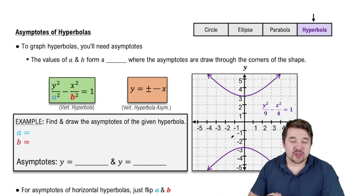
Asymptotes of Hyperbolas
관련 실천
교과서 질문

52-56. In this section, several models are presented and the solution of the associated differential equation is given. Later in the chapter, we present methods for solving these differential equations.


where P(t) is the population, for t ≥ 0, and r > 0 and K > 0 are given constants.


d. Find lim(t→∞) P(t) and check that the result is consistent with the graph in part (c).

54
views
교과서 질문

A physiological model A common assumption in modeling drug assimilation is that the blood volume in a person is a single compartment that behaves like a stirred tank. Suppose the blood volume is a four-liter tank that initially has a zero concentration of a particular drug. At time t = 0, an intravenous line is inserted into a vein (into the tank) that carries a drug solution with a concentration of 500 mg/L. The inflow rate is 0.06 L/min. Assume the drug is quickly mixed thoroughly in the blood and that the volume of blood remains constant.

d. After how many minutes does the drug mass reach 90% of its steady-state level? 

45
views
교과서 질문

29–32. {Use of Tech} Errors in Euler’s method Consider the following initial value problems.


c. Which time step results in the more accurate approximation? Explain your observations.


y′(t) = 4−y, y(0) = 3; y(t) = 4−e⁻ᵗ

35
views
교과서 질문

33–36. {Use of Tech} Computing Euler approximations Use a calculator or computer program to carry out the following steps.

d. Compare the errors in the approximations to y(T).


y′(t) = 6 - 2y, y(0) = -1; Δt = 0.2, T = 3; y(t) = 3 - 4e⁻²ᵗ

54
views
교과서 질문

27–30. Predator-prey models Consider the following pairs of differential equations that model a predator-prey system with populations x and y. In each case, carry out the following steps.

d. Identify the four regions in the first quadrant of the xy-plane in which x' and y' are positive or negative.


x′(t) = 2x − 4xy, y′(t) = −y + 2xy

43
views
교과서 질문

17–20. Increasing and decreasing solutions Consider the following differential equations. A detailed direction field is not needed.


d. Sketch the direction field and verify that it is consistent with parts (a)–(c).


y'(t) = (y−2)(y+1)

32
views