
Ch. 9 - Differential Equations
Briggs - Calculus: Early Transcendentals 3rd Edition
Briggs3rd EditionCalculus: Early TranscendentalsISBN: 9780136847243당신이 사용하는 게 아니라요?교과서 변경
9장, 문제 9.5.32a

Growth rate functions
a. Show that the logistic growth rate function f(P)=rP(1−P/K) has a maximum value of rK/4 at the point P=K/2.

검증된 단계별 안내
1
Start with the logistic growth rate function given by \(f(P) = rP\left(1 - \frac{P}{K}\right)\), where \(r\) and \(K\) are constants, and \(P\) is the variable representing population.
Rewrite the function in a simplified form to make differentiation easier: \(f(P) = rP - \frac{rP^2}{K}\).
Find the critical points by taking the derivative of \(f(P)\) with respect to \(P\) and setting it equal to zero. Compute \(f'(P) = r - \frac{2rP}{K}\) and solve \(f'(P) = 0\) for \(P\).
Solve the equation \(r - \frac{2rP}{K} = 0\) to find the critical point \(P = \frac{K}{2}\).
Verify that this critical point corresponds to a maximum by checking the second derivative \(f''(P) = -\frac{2r}{K}\), which is negative, confirming a maximum at \(P = \frac{K}{2}\). Then, substitute \(P = \frac{K}{2}\) back into the original function to find the maximum value \(f\left(\frac{K}{2}\right) = \frac{rK}{4}\).

비슷한 문제에 대한 검증된 영상 답변:

이 영상 해법은 위 문제에 도움이 된다고 튜터들이 추천한 것입니다.
영상 길이:
5m

주요 개념

질문에 올바르게 답하기 위해 반드시 이해해야 하는 핵심 개념들은 다음과 같습니다.

Logistic Growth Function

The logistic growth function models population growth with a carrying capacity, expressed as f(P) = rP(1 - P/K), where r is the intrinsic growth rate, P is the population size, and K is the carrying capacity. It describes how growth slows as the population approaches K.
추천 영상:
09:29
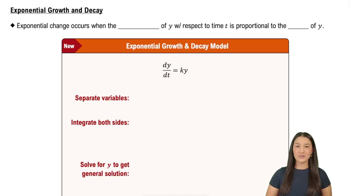
Exponential Growth & Decay

Finding Maximum Values Using Derivatives

To find the maximum value of a function, take its derivative, set it equal to zero, and solve for critical points. Then, use the second derivative test or analyze the function behavior to confirm if the critical point is a maximum.
추천 영상:
05:12
Finding Global Extrema (Extreme Value Theorem)

Substitution and Evaluation of Functions

After finding the critical point, substitute it back into the original function to evaluate the maximum value. This step confirms the exact output of the function at the point where the growth rate is maximized.
추천 영상:
04:27
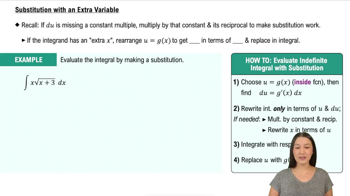
Substitution With an Extra Variable
관련 실천
교과서 질문

43–44. Motion in a gravitational field: An object is fired vertically upward with initial velocity v(0)=v₀ from initial position s(0)=s₀.

a. For the following values of v₀ and s₀, find the position and velocity functions for all times at which the object is above the ground (s = 0).

v₀ = 49 m/s, s₀ = 60 m

52
views
교과서 질문

{Use of Tech} Torricelli’s law An open cylindrical tank initially filled with water drains through a hole in the bottom of the tank according to Torricelli’s law (see figure). If h(t) is the depth of water in the tank for t≥0 s, then Torricelli’s law implies h′(t)=−k√h, where k is a constant that includes g=9.8m/s², the radius of the tank, and the radius of the drain. Assume the initial depth of the water is h(0)=Hm. 

a. Find the solution of the initial value problem.

84
views
교과서 질문

17–20. Increasing and decreasing solutions Consider the following differential equations. A detailed direction field is not needed.


a. Find the solutions that are constant, for all t ≥ 0 (the equilibrium solutions).


y'(t) = (y−2)(y+1)

50
views
교과서 질문

29–32. {Use of Tech} Errors in Euler’s method Consider the following initial value problems.


a. Find the approximations to y(0.2) and y(0.4) using Euler’s method with time steps of Δt = 0.2, 0.1, 0.05, and 0.025.


y′(t) = y/2, y(0) = 2; y(t) = 2eᵗᐟ²

69
views
교과서 질문

42–43. Implicit solutions for separable equations For the following separable equations, carry out the indicated analysis.

a. Find the general solution of the equation.


e⁻ʸᐟ²y'(x) = 4x sin x² − x; y(0) = 0, y(0) = ln(1/4), y(√(π/2)) = 0


42
views
교과서 질문

33–36. {Use of Tech} Computing Euler approximations Use a calculator or computer program to carry out the following steps.

a. Approximate the value of y(T) using Euler’s method with the given time step on the interval [0,T].


y′(t) = -2y, y(0) = 1; Δt = 0.2, T = 2; y(t) = e⁻²ᵗ

61
views