
교과서 질문
22–25. Equilibrium solutions Find the equilibrium solutions of the following equations and determine whether each solution is stable or unstable.
y′(t) = y(3+y)(y-5)
88
views

 검증된 단계별 안내
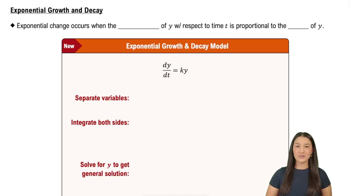
 09:29
09:29
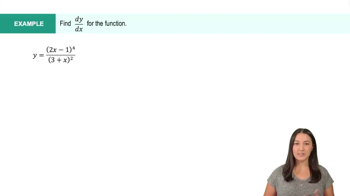 07:39
07:39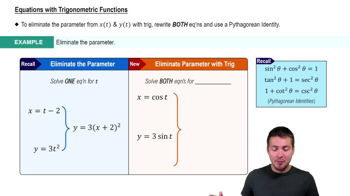 04:11
04:1122–25. Equilibrium solutions Find the equilibrium solutions of the following equations and determine whether each solution is stable or unstable.
y′(t) = y(3+y)(y-5)
2–10. General solutions Use the method of your choice to find the general solution of the following differential equations.
y′(t) = √(y/t)
Explain why or why not Determine whether the following statements are true and give an explanation or counterexample.
d. The direction field for the differential equation y′(t)=t+y(t) is plotted in the ty-plane.
Logistic growth The population of a rabbit community is governed by the initial value problem
P′(t) = 0.2 P (1 − P/1200), P(0) = 50
d. What is the population when the growth rate is a maximum?
A first-order equation Consider the equation t² y′(t) + 2ty(t) = e⁻ᵗ
c. Find the solution that satisfies the condition y(1) = 0
Stirred tank reaction A 100-L tank is filled with pure water when an inflow pipe is opened and a sugar solution with a concentration of 20 gm/L flows into the tank at a rate of 0.5 L/min. The solution is thoroughly mixed and flows out of the tank at a rate of 0.5 L/min.
c. At what time does the mass of sugar reach 95% of its steady-state level?