Ch. 9 - Differential Equations
Briggs - Calculus: Early Transcendentals 3rd Edition
Briggs3rd EditionCalculus: Early TranscendentalsISBN: 9780136847243당신이 사용하는 게 아니라요?교과서 변경
9장, 문제 9.4.31b

{Use of Tech} Intravenous drug dosing The amount of drug in the blood of a patient (in milligrams) administered via an intravenous line is governed by the initial value problem y’(t) = -0.02y + 3, y(0) = 0 where t is measured in hours.


b. What is the steady-state level of the drug?

검증된 단계별 안내
1
Recognize that the steady-state level of the drug corresponds to the equilibrium solution where the amount of drug no longer changes over time. Mathematically, this means setting the derivative \(y'(t)\) to zero: \(0 = -0.02y + 3\).
Solve the equation \(0 = -0.02y + 3\) for \(y\) to find the steady-state concentration. Rearrange it to isolate \(y\): \(0.02y = 3\).
Divide both sides of the equation by \(0.02\) to solve for \(y\): \(y = \frac{3}{0.02}\).
Interpret this value as the long-term amount of drug in the blood when the system reaches equilibrium, meaning the drug input and elimination balance out.
Note that this steady-state value is independent of the initial condition \(y(0) = 0\) because it represents the behavior as \(t \to \infty\).

비슷한 문제에 대한 검증된 영상 답변:

이 영상 해법은 위 문제에 도움이 된다고 튜터들이 추천한 것입니다.
영상 길이:
1m

주요 개념

질문에 올바르게 답하기 위해 반드시 이해해야 하는 핵심 개념들은 다음과 같습니다.

First-Order Linear Differential Equations

This type of differential equation has the form y' + p(t)y = q(t). It models processes where the rate of change depends linearly on the current state and an external input. Solving such equations involves finding an integrating factor or using steady-state analysis.
추천 영상:
07:39
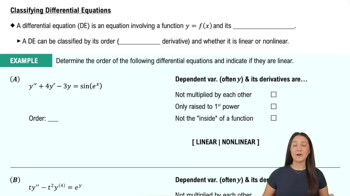
Classifying Differential Equations

Steady-State Solution

The steady-state level is the long-term behavior of the system when the rate of change becomes zero (y' = 0). It represents the equilibrium concentration where the drug input balances the elimination, providing a constant drug level in the blood.
추천 영상:
04:00
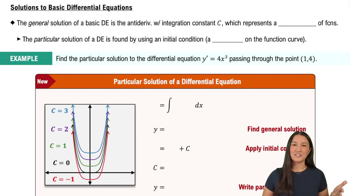
Solutions to Basic Differential Equations

Initial Value Problem (IVP)

An IVP specifies a differential equation along with an initial condition, y(0) = y0, which allows for a unique solution. It models real-world scenarios where the starting state is known, such as the initial drug concentration at time zero.
추천 영상:
가이드 코스
05:03
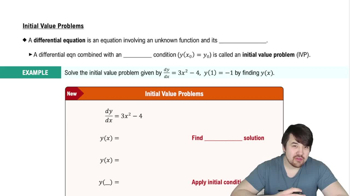
Initial Value Problems
관련 실천
교과서 질문

29–32. {Use of Tech} Errors in Euler’s method Consider the following initial value problems.


b. Using the exact solution given, compute the errors in the Euler approximations at t=0.2 and t=0.4.


y′(t) = −y, y(0) = 1; y(t) = e⁻ᵗ

63
views

교과서 질문

42–43. Implicit solutions for separable equations For the following separable equations, carry out the indicated analysis.

b. Find the value of the arbitrary constant associated with each initial condition. (Each initial condition requires a different constant.)


y'(t) = t²/(y² + 1); y(−1) = 1, y(0) = 0, y(−1) = −1

79
views
교과서 질문

Explain why or why not Determine whether the following statements are true and give an explanation or counterexample


b. If k>0 and b>0 then y(t)=0 is never a solution of y'(t)=ky−b.

44
views
교과서 질문

33–36. {Use of Tech} Computing Euler approximations Use a calculator or computer program to carry out the following steps.

b. Using the exact solution (also given), find the error in the approximation to y(T) (only at the right endpoint of the time interval).


y′(t) = t/y, y(0) = 4; Δt = 0.1, T = 2; y(t) = √(t² + 16)

49
views
교과서 질문

Explain why or why not Determine whether the following statements are true and give an explanation or counterexample.

b. The general solution of the separable equation y'(t) = t/(y' + 10y⁴) can be expressed explicitly with y in terms of t.

48
views
교과서 질문

Euler’s method on more general grids Suppose the solution of the initial value problem y'(t)=f(t,y),y(a)=A is to be approximated on the interval [a, b].

b. Write the first step of Euler’s method to compute u1.

74
views