Ch. 9 - Differential Equations
Briggs - Calculus: Early Transcendentals 3rd Edition
Briggs3rd EditionCalculus: Early TranscendentalsISBN: 9780136847243당신이 사용하는 게 아니라요?교과서 변경
9장, 문제 9.3.49b

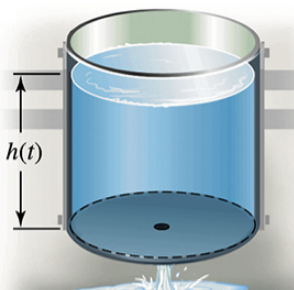
{Use of Tech} Torricelli’s law An open cylindrical tank initially filled with water drains through a hole in the bottom of the tank according to Torricelli’s law (see figure). If h(t) is the depth of water in the tank for t≥0 s, then Torricelli’s law implies h′(t)=−k√h, where k is a constant that includes g=9.8m/s², the radius of the tank, and the radius of the drain. Assume the initial depth of the water is h(0)=Hm. 
b. Find the solution in k=0.1the case that and H=0.5m. 
img

검증된 단계별 안내
1
Start with the given differential equation from Torricelli's law: \(h'(t) = -k \sqrt{h(t)}\), where \(k = 0.1\) and the initial condition is \(h(0) = H = 0.5\) meters.
Rewrite the differential equation in separable form: \(\frac{dh}{dt} = -k \sqrt{h}\) can be rearranged as \(\frac{dh}{\sqrt{h}} = -k \, dt\).
Integrate both sides: integrate \(\frac{1}{\sqrt{h}} \, dh\) on the left and integrate \(-k \, dt\) on the right. Remember to include the constant of integration after integrating.
Solve the integral on the left side, which is \(\int h^{-1/2} \, dh = 2 \sqrt{h}\), and the integral on the right side, which is \(-k t + C\) where \(C\) is the constant of integration.
Use the initial condition \(h(0) = 0.5\) to solve for the constant \(C\), then express \(h(t)\) explicitly as a function of \(t\) by isolating \(h\).

비슷한 문제에 대한 검증된 영상 답변:

이 영상 해법은 위 문제에 도움이 된다고 튜터들이 추천한 것입니다.
영상 길이:
3m

주요 개념

질문에 올바르게 답하기 위해 반드시 이해해야 하는 핵심 개념들은 다음과 같습니다.

Torricelli’s Law

Torricelli’s law describes the speed of fluid flowing out of an orifice under gravity, stating that the rate of change of the water height h(t) is proportional to the square root of h(t). Mathematically, it is expressed as h'(t) = -k√h, where k depends on gravity and the tank and hole dimensions.
추천 영상:
10:44
Newton's Law of Cooling

Separable Differential Equations

The given differential equation h'(t) = -k√h is separable, meaning variables h and t can be separated on opposite sides of the equation. This allows integration with respect to each variable independently to find the explicit solution h(t).
추천 영상:
06:06
Solving Separable Differential Equations

Initial Value Problem (IVP)

An initial value problem involves solving a differential equation with a given initial condition, here h(0) = H. This condition is used to determine the constant of integration after solving the differential equation, ensuring the solution fits the physical scenario.
추천 영상:
가이드 코스
05:03
Initial Value Problems
관련 실천
교과서 질문

29–32. {Use of Tech} Errors in Euler’s method Consider the following initial value problems.


b. Using the exact solution given, compute the errors in the Euler approximations at t=0.2 and t=0.4.


y′(t) = −y, y(0) = 1; y(t) = e⁻ᵗ

63
views

교과서 질문

42–43. Implicit solutions for separable equations For the following separable equations, carry out the indicated analysis.

b. Find the value of the arbitrary constant associated with each initial condition. (Each initial condition requires a different constant.)


y'(t) = t²/(y² + 1); y(−1) = 1, y(0) = 0, y(−1) = −1

79
views
교과서 질문

Euler’s method on more general grids Suppose the solution of the initial value problem y'(t)=f(t,y),y(a)=A is to be approximated on the interval [a, b].

b. Write the first step of Euler’s method to compute u1.

74
views
교과서 질문

27–30. Predator-prey models Consider the following pairs of differential equations that model a predator-prey system with populations x and y. In each case, carry out the following steps.

b. Find the lines along which x'(t) = 0. Find the lines along which y'(t) = 0.


x′(t) = 2x − xy, y′(t) = −y + xy

51
views
교과서 질문

29–32. {Use of Tech} Errors in Euler’s method Consider the following initial value problems.


b. Using the exact solution given, compute the errors in the Euler approximations at t=0.2 and t=0.4.


y′(t) = 2t + 1, y(0) = 0; y(t) = t² + t

67
views
교과서 질문

brOrthogonal trajectories Two curves are orthogonal to each other if their tangent lines are perpendicular at each point of intersection. A family of curves forms orthogonal trajectories with another family of curves if each curve in one family is orthogonal to each curve in the other family. Use the following steps to find the orthogonal trajectories of the family of ellipses 2x² + y² = a²


b. The family of trajectories orthogonal to 2x² + y² = a² satisfies the differential equation dy/dx = y/(2x). Why?

81
views