Ch.12 - Parametric and Polar Curves
Briggs - Calculus: Early Transcendentals 3rd Edition
Briggs3rd EditionCalculus: Early TranscendentalsISBN: 9780136847243당신이 사용하는 게 아니라요?교과서 변경
12장, 문제 12.4.16

13–30. Graphing conic sections Determine whether the following equations describe a parabola, an ellipse, or a hyperbola, and then sketch a graph of the curve. For each parabola, specify the location of the focus and the equation of the directrix; for each ellipse, label the coordinates of the vertices and foci, and find the lengths of the major and minor axes; for each hyperbola, label the coordinates of the vertices and foci, and find the equations of the asymptotes.


x²/9 + y²/4 = 1

검증된 단계별 안내
1
Identify the type of conic section by examining the given equation: \(\frac{x^2}{9} + \frac{y^2}{4} = 1\). Since both \(x^2\) and \(y^2\) terms are positive and added together, this equation represents an ellipse.
Recall the standard form of an ellipse centered at the origin: \(\frac{x^2}{a^2} + \frac{y^2}{b^2} = 1\), where \(a^2\) and \(b^2\) are the denominators under \(x^2\) and \(y^2\) respectively. Determine which is larger between \(a^2\) and \(b^2\) to identify the major and minor axes.
Calculate the lengths of the major and minor axes. The length of the major axis is \$2a\( and the length of the minor axis is \)2b$. Here, \(a = \sqrt{9}\) and \(b = \sqrt{4}\).
Find the coordinates of the vertices. If \(a^2\) is under \(x^2\), the major axis is along the x-axis, so vertices are at \((\pm a, 0)\). If \(a^2\) is under \(y^2\), the major axis is along the y-axis, so vertices are at \((0, \pm a)\).
Determine the foci using the formula \(c^2 = a^2 - b^2\). Calculate \(c\), then locate the foci at \((\pm c, 0)\) if the major axis is horizontal, or at \((0, \pm c)\) if vertical. Finally, sketch the ellipse labeling the vertices and foci accordingly.

비슷한 문제에 대한 검증된 영상 답변:

이 영상 해법은 위 문제에 도움이 된다고 튜터들이 추천한 것입니다.
영상 길이:
3m
도움이 되었나요?

주요 개념

질문에 올바르게 답하기 위해 반드시 이해해야 하는 핵심 개념들은 다음과 같습니다.

Identification of Conic Sections

Conic sections are curves obtained by intersecting a plane with a cone, resulting in parabolas, ellipses, or hyperbolas. The general form of their equations helps identify the type: an ellipse has both squared terms positive and added, a hyperbola has squared terms subtracted, and a parabola has only one squared term. Recognizing these forms is essential for classifying the given equation.
추천 영상:
5:33
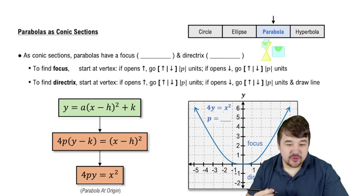
Parabolas as Conic Sections

Properties and Features of Ellipses

An ellipse is defined by its major and minor axes, vertices, and foci. The major axis is the longest diameter, and the minor axis is perpendicular to it. The sum of distances from any point on the ellipse to the two foci is constant. Knowing how to find vertices, foci, and axis lengths from the standard form equation is crucial for graphing and analysis.
추천 영상:
06:21
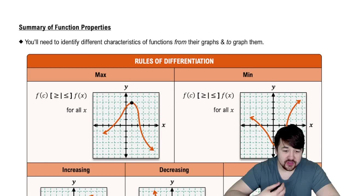
Properties of Functions

Graphing and Labeling Conic Sections

Graphing conic sections involves plotting key points such as vertices and foci, and drawing the curve accordingly. For ellipses, labeling the vertices and foci and indicating the lengths of the major and minor axes helps visualize the shape. Understanding how to translate the equation into a graph ensures accurate representation and interpretation.
추천 영상:
5:33
Parabolas as Conic Sections