Ch.12 - Parametric and Polar Curves
Briggs - Calculus: Early Transcendentals 3rd Edition
Briggs3rd EditionCalculus: Early TranscendentalsISBN: 9780136847243당신이 사용하는 게 아니라요?교과서 변경
12장, 문제 12.3.49

45–60. Areas of regions Find the area of the following regions.


The region inside one leaf of the rose r = cos 5θ

검증된 단계별 안내
1
Recognize that the given curve is a rose curve defined by the polar equation \(r = \cos(5\theta)\). This curve has 5 petals because the coefficient of \(\theta\) inside the cosine is 5.
Recall that the area \(A\) enclosed by one petal of a rose curve \(r = \cos(k\theta)\) (where \(k\) is an integer) can be found using the integral formula for polar areas: \(A = \frac{1}{2} \int_{\alpha}^{\beta} r^2 \, d\theta\)
Determine the limits of integration \(\alpha\) and \(\beta\) that correspond to one leaf (one petal) of the rose. Since the rose has 5 petals, one petal corresponds to an interval of \(\frac{2\pi}{5}\) radians. You can find the exact interval by solving \(r = 0\) to find where the petal starts and ends, or use symmetry and set \(\theta\) from \(0\) to \(\frac{\pi}{5}\).
Set up the integral for the area of one petal: \(A = \frac{1}{2} \int_{0}^{\frac{\pi}{5}} \left( \cos(5\theta) \right)^2 \, d\theta\)
Use the trigonometric identity \(\cos^2 x = \frac{1 + \cos(2x)}{2}\) to simplify the integrand before integrating. Then, integrate with respect to \(\theta\) over the chosen limits to find the area of one petal.

비슷한 문제에 대한 검증된 영상 답변:

이 영상 해법은 위 문제에 도움이 된다고 튜터들이 추천한 것입니다.
영상 길이:
4m

주요 개념

질문에 올바르게 답하기 위해 반드시 이해해야 하는 핵심 개념들은 다음과 같습니다.

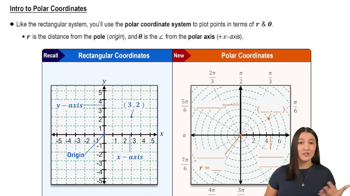
Polar Coordinates and Graphs

Polar coordinates represent points using a radius and an angle, expressed as (r, θ). Graphs like r = cos 5θ produce rose curves with multiple petals, where the number of petals depends on the coefficient of θ. Understanding how to interpret and sketch these curves is essential for identifying the region whose area is to be found.
추천 영상:
05:32
Intro to Polar Coordinates

Area in Polar Coordinates

The area enclosed by a curve in polar coordinates is found using the integral formula A = (1/2) ∫ r(θ)^2 dθ over the appropriate interval. This formula accounts for the sector-like shape of regions defined by polar functions, making it crucial for calculating areas of petals in rose curves.
추천 영상:
05:32
Intro to Polar Coordinates

Determining Limits of Integration for One Petal

To find the area of one leaf of a rose curve, it is necessary to determine the correct angular interval that traces exactly one petal. For r = cos 5θ, one petal corresponds to an interval of length π/5, derived from the periodicity and symmetry of the function. Setting proper limits ensures the integral covers only the desired region.
추천 영상:
05:50
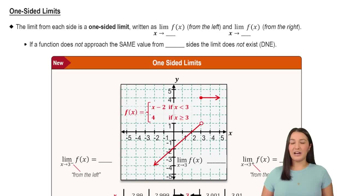
One-Sided Limits
관련 실천
교과서 질문

57–62. Polar equations for conic sections Graph the following conic sections, labeling the vertices, foci, directrices, and asymptotes (if they exist). Use a graphing utility to check your work.


r = 3/(2 + cos θ)

37
views
교과서 질문

41–44. Intersection points and area  Find all the intersection points of the following curves. Find the area of the entire region that lies within both curves


r = 1 + sin θ and r = 1 + cos θ

43
views
교과서 질문

Golden Gate Bridge Completed in 1937, San Francisco’s Golden Gate Bridge is 2.7 km long and weighs about 890,000 tons. The length of the span between the two central towers is 1280 m; the towers themselves extend 152 m above the roadway. The cables that support the deck of the bridge between the two towers hang in a parabola (see figure). Assuming the origin is midway between the towers on the deck of the bridge, find an equation that describes the cables. How long is a guy wire that hangs vertically from the cables to the roadway 500 m from the center of the bridge? 

115
views
교과서 질문

31–36. Eliminating the parameter Eliminate the parameter to express the following parametric equations as a single equation in x and y.


x=t,y= √(4−t²) a

87
views
교과서 질문

63–66. Tracing hyperbolas and parabolas Graph the following equations. Then use arrows and labeled points to indicate how the curve is generated as θ increases from 0 to 2π. 


r = 3/(1 - cos θ)

45
views
교과서 질문

63–74. Arc length of polar curves Find the length of the following polar curves.


{Use of Tech} The complete limaçon r=4−2cosθ

96
views