Ch.12 - Parametric and Polar Curves
Briggs - Calculus: Early Transcendentals 3rd Edition
Briggs3rd EditionCalculus: Early TranscendentalsISBN: 9780136847243당신이 사용하는 게 아니라요?교과서 변경
12장, 문제 71

63–74. Arc length of polar curves Find the length of the following polar curves.


The curve r = sin³(θ/3), for 0 ≤ θ ≤ π/2

검증된 단계별 안내
1
Recall the formula for the arc length \( L \) of a polar curve \( r = r(\theta) \) from \( \theta = a \) to \( \theta = b \): \[ L = \int_a^b \sqrt{r(\theta)^2 + \left(\frac{d r}{d \theta}\right)^2} \, d\theta \]
Identify the given function and interval: \( r(\theta) = \sin^3\left(\frac{\theta}{3}\right) \) and \( \theta \) ranges from 0 to \( \frac{\pi}{2} \).
Compute the derivative \( \frac{d r}{d \theta} \) using the chain rule: First, write \( r(\theta) = \left( \sin\left(\frac{\theta}{3}\right) \right)^3 \). Then, \[ \frac{d r}{d \theta} = 3 \sin^2\left(\frac{\theta}{3}\right) \cdot \cos\left(\frac{\theta}{3}\right) \cdot \frac{1}{3} = \sin^2\left(\frac{\theta}{3}\right) \cos\left(\frac{\theta}{3}\right) \]
Substitute \( r(\theta) \) and \( \frac{d r}{d \theta} \) into the arc length formula: \[ L = \int_0^{\frac{\pi}{2}} \sqrt{ \sin^6\left(\frac{\theta}{3}\right) + \left( \sin^2\left(\frac{\theta}{3}\right) \cos\left(\frac{\theta}{3}\right) \right)^2 } \, d\theta \]
Simplify the expression inside the square root if possible, then evaluate the integral over the interval \( 0 \leq \theta \leq \frac{\pi}{2} \) to find the arc length.

비슷한 문제에 대한 검증된 영상 답변:

이 영상 해법은 위 문제에 도움이 된다고 튜터들이 추천한 것입니다.
영상 길이:
4m

주요 개념

질문에 올바르게 답하기 위해 반드시 이해해야 하는 핵심 개념들은 다음과 같습니다.

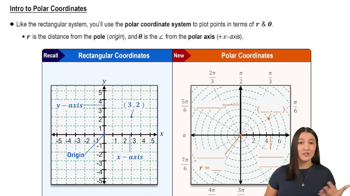
Polar Coordinates and Curves

Polar coordinates represent points in the plane using a radius and an angle (r, θ). Polar curves are defined by equations relating r and θ, such as r = sin³(θ/3). Understanding how to interpret and plot these curves is essential for analyzing their properties, including length.
추천 영상:
05:32
Intro to Polar Coordinates

Arc Length Formula for Polar Curves

The arc length of a polar curve r(θ) from θ = a to θ = b is given by the integral ∫ₐᵇ √[r(θ)² + (dr/dθ)²] dθ. This formula accounts for changes in both radius and angle, allowing calculation of the curve's length by integrating over the specified interval.
추천 영상:
가이드 코스
06:29
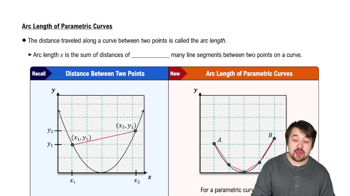
Arc Length of Parametric Curves

Differentiation of Polar Functions

To apply the arc length formula, one must compute the derivative dr/dθ accurately. This involves differentiating functions like r = sin³(θ/3) using the chain rule and power rule, which is crucial for evaluating the integral that determines the curve's length.
추천 영상:
05:32
Intro to Polar Coordinates