
Ch.12 - Parametric and Polar Curves
Briggs - Calculus: Early Transcendentals 3rd Edition
Briggs3rd EditionCalculus: Early TranscendentalsISBN: 9780136847243당신이 사용하는 게 아니라요?교과서 변경
12장, 문제 12.1.71a

67–72. Derivatives Consider the following parametric curves.
a. Determine dy/dx in terms of t and evaluate it at the given value of t.


x = t + 1/t, y = t − 1/t; t = 1

검증된 단계별 안내
1
Identify the parametric equations given: \(x = t + \frac{1}{t}\) and \(y = t - \frac{1}{t}\).
Find the derivatives of \(x\) and \(y\) with respect to the parameter \(t\). Compute \(\frac{dx}{dt}\) and \(\frac{dy}{dt}\) by differentiating each expression:
\[\frac{dx}{dt} = 1 - \frac{1}{t^2}\]
\[\frac{dy}{dt} = 1 + \frac{1}{t^2}\]
Use the chain rule for parametric curves to find \(\frac{dy}{dx}\) by dividing \(\frac{dy}{dt}\) by \(\frac{dx}{dt}\):
\[\frac{dy}{dx} = \frac{\frac{dy}{dt}}{\frac{dx}{dt}} = \frac{1 + \frac{1}{t^2}}{1 - \frac{1}{t^2}}\]
Evaluate \(\frac{dy}{dx}\) at the given value \(t = 1\) by substituting \(t = 1\) into the expression.

비슷한 문제에 대한 검증된 영상 답변:

이 영상 해법은 위 문제에 도움이 된다고 튜터들이 추천한 것입니다.
영상 길이:
3m
도움이 되었나요?

주요 개념

질문에 올바르게 답하기 위해 반드시 이해해야 하는 핵심 개념들은 다음과 같습니다.

Parametric Equations

Parametric equations express the coordinates of points on a curve as functions of a parameter, usually denoted t. Instead of y as a function of x, both x and y depend on t, allowing the description of more complex curves. Understanding how to work with these equations is essential for analyzing the curve's behavior.
추천 영상:
08:02
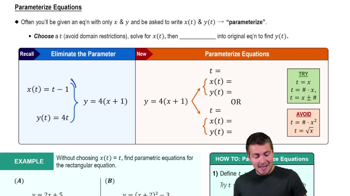
Parameterizing Equations

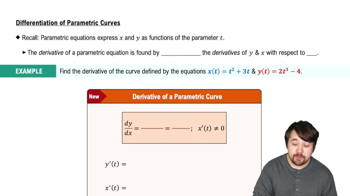
Derivative of Parametric Curves (dy/dx)

For parametric curves, the derivative dy/dx is found by dividing the derivative of y with respect to t by the derivative of x with respect to t, i.e., (dy/dt) / (dx/dt). This method allows us to find the slope of the tangent line to the curve at any parameter value t.
추천 영상:
가이드 코스
06:49
Differentiation of Parametric Curves

Evaluating Derivatives at a Specific Parameter Value

After finding the general expression for dy/dx in terms of t, substituting the given value of t allows us to find the slope of the curve at that specific point. This step is crucial for understanding the curve's instantaneous rate of change or tangent line slope at that parameter.
추천 영상:
5:10
Evaluate Composite Functions - Values on Unit Circle
관련 실천
교과서 질문

11–14. Working with parametric equations Consider the following parametric equations.

a. Make a brief table of values of t, x, and y.

b. Plot the (x, y) pairs in the table and the complete parametric curve, indicating the positive orientation (the direction of increasing t).


x=−t+6, y=3t−3; −5≤t≤5 

69
views
교과서 질문

11–14. Working with parametric equations Consider the following parametric equations.

a. Make a brief table of values of t, x, and y.

b. Plot the (x, y) pairs in the table and the complete parametric curve, indicating the positive orientation (the direction of increasing t).


x=2 t,y=3t−4;−10≤d≤10 

52
views
교과서 질문

The ellipse and the parabola: Let R be the region bounded by the upper half of the ellipse x²/2 + y² = 1 and the parabola y = x²/√2

a. Find the area of R

105
views
교과서 질문

Area of roses Assume m is a positive integer.


a. Even number of leaves: What is the relationship between the total area enclosed by the 4m-leaf rose r=cos(2mθ) and m?

26
views
교과서 질문

Area of a sector of a hyperbola: Consider the region R bounded by the right branch of the hyperbola x²/a² - y²/b² = 1 and the vertical line through the right focus

a. What is the area of R?

89
views
교과서 질문

Explain why or why not Determine whether the following statements are true and give an explanation or counterexample.  


a. The point with Cartesian coordinates (−2, 2) has polar coordinates (2√2, 3π/4), (2√2, 11π/4), (2√2, −5π/4), and (−2√2,−π/4).  

40
views