Ch.12 - Parametric and Polar Curves
Briggs - Calculus: Early Transcendentals 3rd Edition
Briggs3rd EditionCalculus: Early TranscendentalsISBN: 9780136847243당신이 사용하는 게 아니라요?교과서 변경
12장, 문제 12.3.1

Express the polar equation r=f(θ) in parametric form in Cartesian coordinates, where θ is the parameter.

검증된 단계별 안내
1
Recall the relationship between polar and Cartesian coordinates: \(x = r \cos(\theta)\) and \(y = r \sin(\theta)\), where \(r\) is the radius and \(\theta\) is the angle parameter.
Given the polar equation \(r = f(\theta)\), substitute \(r\) into the Cartesian coordinate formulas to express \(x\) and \(y\) in terms of \(\theta\).
Write the parametric equations as \(x(\theta) = f(\theta) \cdot \cos(\theta)\) and \(y(\theta) = f(\theta) \cdot \sin(\theta)\).
Note that \(\theta\) serves as the parameter that varies, typically within an interval such as \([0, 2\pi]\), to trace the curve in the Cartesian plane.
Thus, the polar equation \(r = f(\theta)\) is expressed in parametric form as \(\left(x(\theta), y(\theta)\right) = \left(f(\theta) \cos(\theta), f(\theta) \sin(\theta)\right)\).

비슷한 문제에 대한 검증된 영상 답변:

이 영상 해법은 위 문제에 도움이 된다고 튜터들이 추천한 것입니다.
영상 길이:
1m
도움이 되었나요?

주요 개념

질문에 올바르게 답하기 위해 반드시 이해해야 하는 핵심 개념들은 다음과 같습니다.

Polar Coordinates

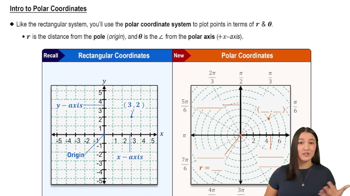
Polar coordinates represent points in a plane using a radius and an angle (r, θ) from the origin. The radius r is the distance from the origin, and θ is the angle measured from the positive x-axis. Understanding this system is essential to convert between polar and Cartesian forms.
추천 영상:
05:32
Intro to Polar Coordinates

Parametric Equations

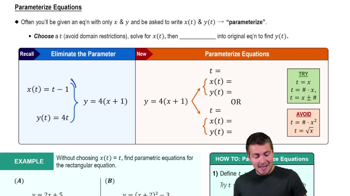
Parametric equations express coordinates as functions of a parameter, often denoted t or θ. Instead of y as a function of x, both x and y are defined separately in terms of the parameter, allowing more flexible representations of curves, including those defined in polar form.
추천 영상:
가이드 코스
08:02
Parameterizing Equations

Conversion from Polar to Cartesian Coordinates

To convert polar equations to Cartesian form, use the relationships x = r cos(θ) and y = r sin(θ). When r is given as a function of θ, substituting r = f(θ) into these formulas yields parametric equations x(θ) and y(θ) in Cartesian coordinates.
추천 영상:
05:32
Intro to Polar Coordinates