Ch.12 - Parametric and Polar Curves
Briggs - Calculus: Early Transcendentals 3rd Edition
Briggs3rd EditionCalculus: Early TranscendentalsISBN: 9780136847243당신이 사용하는 게 아니라요?교과서 변경
12장, 문제 12.3.82e

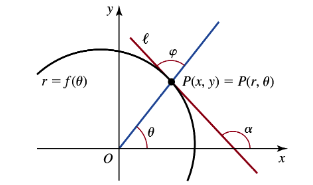
Tangents and normals: Let a polar curve be described by r = f(θ), and let ℓ be the line tangent to the curve at the point P(x,y) = P(r,θ) (see figure).
e. Prove that the values of θ for which ℓ is parallel to the y-axis satisfy tan θ = f(θ)/f'(θ).


Graph of a polar curve r = f(θ) with tangent line ℓ at point P(r, θ), showing angles θ, φ, and α.

검증된 단계별 안내
1
Recall that the polar coordinates \((r, \theta)\) relate to Cartesian coordinates \((x, y)\) by the equations \(x = r \cos \theta\) and \(y = r \sin \theta\), where \(r = f(\theta)\) for the given curve.
To find the slope of the tangent line \(\ell\) at point \(P\), we need to compute \(\frac{dy}{dx}\). Using the chain rule, express \(\frac{dy}{dx}\) as \(\frac{\frac{dy}{d\theta}}{\frac{dx}{d\theta}}\).
Calculate \(\frac{dx}{d\theta}\) and \(\frac{dy}{d\theta}\) using the product rule: \(\frac{dx}{d\theta} = f'(\theta) \cos \theta - f(\theta) \sin \theta\), \(\frac{dy}{d\theta} = f'(\theta) \sin \theta + f(\theta) \cos \theta\).
Substitute these derivatives into the expression for the slope of the tangent line: \(\frac{dy}{dx} = \frac{f'(\theta) \sin \theta + f(\theta) \cos \theta}{f'(\theta) \cos \theta - f(\theta) \sin \theta}\).
Since the tangent line \(\ell\) is parallel to the y-axis, its slope is undefined, which means the denominator of \(\frac{dy}{dx}\) must be zero: \(f'(\theta) \cos \theta - f(\theta) \sin \theta = 0\). Rearranging this gives: \(f'(\theta) \cos \theta = f(\theta) \sin \theta\), which leads to \(\tan \theta = \frac{f(\theta)}{f'(\theta)}\). This completes the proof.

비슷한 문제에 대한 검증된 영상 답변:

이 영상 해법은 위 문제에 도움이 된다고 튜터들이 추천한 것입니다.
영상 길이:
5m

주요 개념

질문에 올바르게 답하기 위해 반드시 이해해야 하는 핵심 개념들은 다음과 같습니다.

Polar Coordinates and Conversion to Cartesian Coordinates

Polar coordinates represent points using a radius r and angle θ, where x = r cos θ and y = r sin θ. Understanding this conversion is essential to relate the polar curve r = f(θ) to Cartesian coordinates (x, y), which helps analyze tangents and normals in the xy-plane.
추천 영상:
05:32
Intro to Polar Coordinates

Slope of the Tangent Line to a Polar Curve

The slope of the tangent line to a polar curve at a point is given by dy/dx, which can be found using the chain rule: dy/dx = (dy/dθ) / (dx/dθ). This requires differentiating x = r cos θ and y = r sin θ with respect to θ, incorporating both f(θ) and its derivative f'(θ).
추천 영상:
가이드 코스
05:13
Slopes of Tangent Lines

Condition for a Line to be Parallel to the y-axis

A line is parallel to the y-axis if its slope is undefined, meaning dx/dθ = 0 (vertical tangent). Using this condition on the derivatives of x and y with respect to θ leads to the relationship tan θ = f(θ)/f'(θ), which characterizes the angles θ where the tangent line is vertical.
추천 영상:
06:30
Disk Method Using y-Axis