Ch. 1 - Functions
Hass - Thomas' Calculus 15th Edition
Hass15th EditionThomas' CalculusISBN: 9780137616077당신이 사용하는 게 아니라요?교과서 변경
1장, 문제 1.2.4

Algebraic Combinations


In Exercises 3 and 4, find the domains of f, g, f/g and g/f.


f(x) = 1, g(x) = 1 + √x

검증된 단계별 안내
1
Step 1: Determine the domain of f(x) = 1. Since f(x) is a constant function, it is defined for all real numbers. Therefore, the domain of f is all real numbers, which can be expressed as (-∞, ∞).
Step 2: Determine the domain of g(x) = 1 + √x. The square root function √x is defined for x ≥ 0. Therefore, the domain of g is [0, ∞).
Step 3: Determine the domain of the quotient f/g. The function f/g(x) = 1 / (1 + √x) is defined where both f and g are defined and g(x) ≠ 0. Since g(x) = 1 + √x is never zero for x ≥ 0, the domain of f/g is [0, ∞).
Step 4: Determine the domain of the quotient g/f. The function g/f(x) = (1 + √x) / 1 is defined where both g and f are defined. Since f(x) = 1 is never zero, the domain of g/f is the intersection of the domains of g and f, which is [0, ∞).
Step 5: Summarize the domains: The domain of f is (-∞, ∞), the domain of g is [0, ∞), the domain of f/g is [0, ∞), and the domain of g/f is [0, ∞).

비슷한 문제에 대한 검증된 영상 답변:

이 영상 해법은 위 문제에 도움이 된다고 튜터들이 추천한 것입니다.
영상 길이:
4m

주요 개념

질문에 올바르게 답하기 위해 반드시 이해해야 하는 핵심 개념들은 다음과 같습니다.

Domain of a Function

The domain of a function is the set of all possible input values (x-values) for which the function is defined. For example, in the function g(x) = 1 + √x, the domain is restricted to x ≥ 0 because the square root of a negative number is not defined in the real number system.
추천 영상:
가이드 코스
5:10
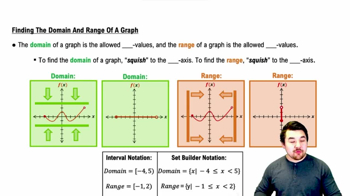
Finding the Domain and Range of a Graph

Algebraic Combinations of Functions

Algebraic combinations of functions involve operations such as addition, subtraction, multiplication, and division of two or more functions. For instance, f/g and g/f represent the division of functions f and g, which requires careful consideration of their domains to avoid undefined expressions, particularly where the denominator equals zero.
추천 영상:
가이드 코스
5:56
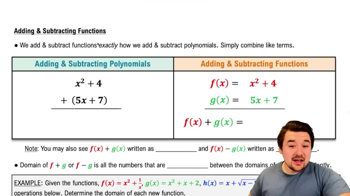
Adding & Subtracting Functions

Restrictions on Domains

When combining functions, certain restrictions may apply to the resulting function's domain. For example, in the case of f/g, the domain must exclude any x-values that make g(x) = 0, as division by zero is undefined. Therefore, analyzing the individual domains of f and g is crucial to determine the overall domain of their combination.
추천 영상:
가이드 코스
5:10
Finding the Domain and Range of a Graph