Ch. 1 - Functions
Hass - Thomas' Calculus 15th Edition
Hass15th EditionThomas' CalculusISBN: 9780137616077당신이 사용하는 게 아니라요?교과서 변경
1장, 문제 1.1.54

Even and Odd Functions


In Exercises 47–62, say whether the function is even, odd, or neither. Give reasons for your answer.


g(x) = x/(x² − 1)

검증된 단계별 안내
1
To determine if a function is even, odd, or neither, we need to evaluate the function at -x and compare it to the original function g(x).
Calculate g(-x) by substituting -x into the function: g(-x) = (-x)/((-x)² - 1).
Simplify g(-x): Since (-x)² = x², we have g(-x) = -x/(x² - 1).
Compare g(-x) with g(x): g(x) = x/(x² - 1) and g(-x) = -x/(x² - 1). Notice that g(-x) = -g(x).
Since g(-x) = -g(x), the function g(x) is odd. A function is odd if g(-x) = -g(x) for all x in the domain of the function.

비슷한 문제에 대한 검증된 영상 답변:

이 영상 해법은 위 문제에 도움이 된다고 튜터들이 추천한 것입니다.
영상 길이:
2m
도움이 되었나요?

주요 개념

질문에 올바르게 답하기 위해 반드시 이해해야 하는 핵심 개념들은 다음과 같습니다.

Even Functions

A function is classified as even if it satisfies the condition f(-x) = f(x) for all x in its domain. This means that the graph of an even function is symmetric with respect to the y-axis. A common example of an even function is f(x) = x², where substituting -x yields the same output as substituting x.
추천 영상:
6:13
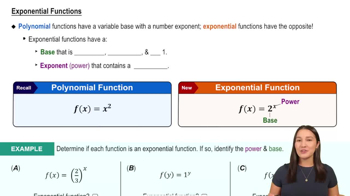
Exponential Functions

Odd Functions

A function is considered odd if it meets the condition f(-x) = -f(x) for all x in its domain. This indicates that the graph of an odd function is symmetric with respect to the origin. An example of an odd function is f(x) = x³, where substituting -x results in the negative of the output for x.
추천 영상:
06:21
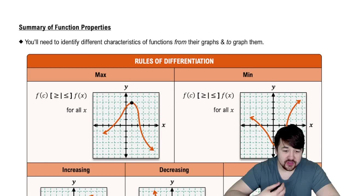
Properties of Functions

Function Analysis

Analyzing a function involves evaluating its behavior under transformations, such as substituting -x for x. This process helps determine whether the function is even, odd, or neither. For the function g(x) = x/(x² - 1), one must compute g(-x) and compare it to g(x) and -g(x) to classify its symmetry.
추천 영상:
06:29
Derivatives Applied To Velocity