Ch. 1 - Functions
Hass - Thomas' Calculus 15th Edition
Hass15th EditionThomas' CalculusISBN: 9780137616077당신이 사용하는 게 아니라요?교과서 변경
1장, 문제 1.1.6

Functions


In Exercises 1–6, find the domain and range of each function.


G(t) = 2/(t² − 16)

검증된 단계별 안내
1
Step 1: Identify the function G(t) = 2/(t² − 16). This is a rational function, which means it is a fraction with a polynomial in the denominator.
Step 2: Determine the domain of the function. The domain consists of all real numbers except those that make the denominator zero. Set the denominator equal to zero: t² − 16 = 0.
Step 3: Solve the equation t² − 16 = 0 to find the values of t that are not in the domain. This can be factored as (t - 4)(t + 4) = 0, giving t = 4 and t = -4.
Step 4: The domain of G(t) is all real numbers except t = 4 and t = -4. In interval notation, this is expressed as (-∞, -4) ∪ (-4, 4) ∪ (4, ∞).
Step 5: Determine the range of the function. Since the function is a rational function and the numerator is a constant, the range is all real numbers except the value that the function approaches as t approaches the values that make the denominator zero. Analyze the behavior of the function as t approaches 4 and -4 to determine the range.

비슷한 문제에 대한 검증된 영상 답변:

이 영상 해법은 위 문제에 도움이 된다고 튜터들이 추천한 것입니다.
영상 길이:
2m
도움이 되었나요?

주요 개념

질문에 올바르게 답하기 위해 반드시 이해해야 하는 핵심 개념들은 다음과 같습니다.

Domain of a Function

The domain of a function refers to the set of all possible input values (x-values) for which the function is defined. For rational functions like G(t) = 2/(t² − 16), the domain excludes any values that make the denominator zero, as division by zero is undefined. In this case, the domain is all real numbers except for the values that satisfy t² - 16 = 0.
추천 영상:
5:10
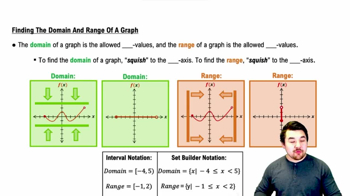
Finding the Domain and Range of a Graph

Range of a Function

The range of a function is the set of all possible output values (y-values) that the function can produce. For the function G(t) = 2/(t² − 16), the range can be determined by analyzing the behavior of the function as t approaches the values that are excluded from the domain and as t approaches infinity. Understanding the asymptotic behavior helps in identifying the range.
추천 영상:
5:10
Finding the Domain and Range of a Graph

Vertical Asymptotes

Vertical asymptotes occur in rational functions where the denominator approaches zero, causing the function to approach infinity or negative infinity. For G(t) = 2/(t² − 16), vertical asymptotes exist at the values of t that make the denominator zero, specifically t = 4 and t = -4. These asymptotes indicate where the function is undefined and help in sketching the graph of the function.
추천 영상:
3:40
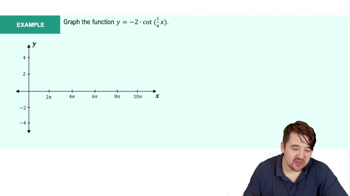
Introduction to Cotangent Graph Example 1