Ch. 1 - Functions
Hass - Thomas' Calculus 15th Edition
Hass15th EditionThomas' CalculusISBN: 9780137616077당신이 사용하는 게 아니라요?교과서 변경
1장, 문제 1.1.46

Increasing and Decreasing Functions


Graph the functions in Exercises 37–46. What symmetries, if any, do the graphs have? Specify the intervals over which the function is increasing and the intervals where it is decreasing.


y = (−x)²/³

검증된 단계별 안내
1
First, understand the function y = (-x)^(2/3). This function involves a fractional exponent, which can be rewritten as y = ((-x)^2)^(1/3). This means we are taking the cube root of the square of -x.
Next, consider the symmetry of the function. A function is symmetric about the y-axis if f(x) = f(-x) for all x in the domain. Substitute -x into the function: y = ((-(-x))^2)^(1/3) = (x^2)^(1/3). Since this is equal to the original function, the graph is symmetric about the y-axis.
To determine where the function is increasing or decreasing, find the derivative of y with respect to x. Use the chain rule: if y = u^(1/3) where u = (-x)^2, then dy/dx = (1/3)u^(-2/3) * du/dx. Calculate du/dx = 2(-x)(-1) = 2x.
Substitute du/dx into the derivative: dy/dx = (1/3)((-x)^2)^(-2/3) * 2x. Simplify this expression to find the critical points where the derivative is zero or undefined, which will help identify intervals of increase and decrease.
Analyze the sign of the derivative on intervals determined by the critical points. If dy/dx > 0, the function is increasing on that interval; if dy/dx < 0, the function is decreasing. Use this information to specify the intervals of increase and decrease for the function.

비슷한 문제에 대한 검증된 영상 답변:

이 영상 해법은 위 문제에 도움이 된다고 튜터들이 추천한 것입니다.
영상 길이:
6m
도움이 되었나요?

주요 개념

질문에 올바르게 답하기 위해 반드시 이해해야 하는 핵심 개념들은 다음과 같습니다.

Increasing and Decreasing Functions

A function is considered increasing on an interval if, for any two points within that interval, the function's value at the second point is greater than at the first. Conversely, a function is decreasing if the value at the second point is less than at the first. Identifying these intervals involves analyzing the first derivative of the function, where positive values indicate increasing behavior and negative values indicate decreasing behavior.
추천 영상:
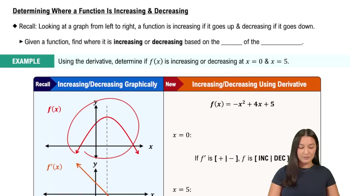
07:32
Determining Where a Function is Increasing & Decreasing

Graphing Functions

Graphing a function involves plotting its points on a coordinate plane to visualize its behavior. This includes identifying key features such as intercepts, turning points, and asymptotes. For the function y = (−x)²/³, understanding its shape and symmetry is crucial, as it helps in determining where the function increases or decreases and how it behaves at different values of x.
추천 영상:
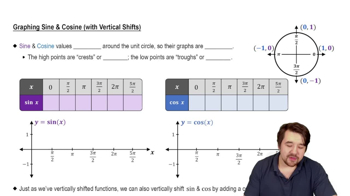
5:53
Graph of Sine and Cosine Function

Symmetry in Functions

Symmetry in functions refers to the property where a function exhibits a mirror-like behavior about a specific axis or point. For example, a function is even if f(x) = f(-x) for all x, indicating symmetry about the y-axis, and odd if f(-x) = -f(x), indicating symmetry about the origin. Analyzing the symmetry of the function y = (−x)²/³ can provide insights into its overall shape and the intervals of increase and decrease.
추천 영상:
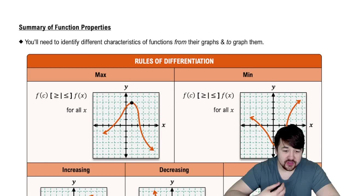
06:21
Properties of Functions