Ch. 1 - Functions
Hass - Thomas' Calculus 15th Edition
Hass15th EditionThomas' CalculusISBN: 9780137616077당신이 사용하는 게 아니라요?교과서 변경
1장, 문제 53e

Shifting and Scaling Graphs


Suppose the graph of g is given. Write equations for the graphs that are obtained from the graph of g by shifting, scaling, or reflecting, as indicated.


e. Stretch vertically by a factor of 5

검증된 단계별 안내
1
Start with the original function g(x). To stretch the graph vertically, you will multiply the entire function by a constant factor.
Identify the factor by which you want to stretch the graph vertically. In this case, the factor is 5.
Multiply the function g(x) by the factor 5. This means you will write the new function as 5 * g(x).
Understand that multiplying the function by 5 will make all the y-values of the graph five times larger, effectively stretching the graph vertically.
The equation for the vertically stretched graph is y = 5 * g(x). This represents the transformation applied to the original graph.

비슷한 문제에 대한 검증된 영상 답변:

이 영상 해법은 위 문제에 도움이 된다고 튜터들이 추천한 것입니다.
영상 길이:
1m
도움이 되었나요?

주요 개념

질문에 올바르게 답하기 위해 반드시 이해해야 하는 핵심 개념들은 다음과 같습니다.

Vertical Stretch

A vertical stretch occurs when the output values of a function are multiplied by a factor greater than 1. For example, if the function g(x) is transformed to 5g(x), every point on the graph of g is moved away from the x-axis by a factor of 5, effectively stretching the graph vertically. This transformation increases the height of the graph while maintaining the same x-coordinates.
추천 영상:
5:25
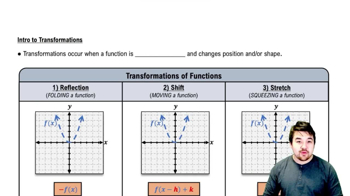
Intro to Transformations

Function Transformation

Function transformations involve altering the graph of a function through shifts, stretches, or reflections. These transformations can be represented mathematically by modifying the function's equation. Understanding how to apply these transformations allows one to predict the new position and shape of the graph based on the original function.
추천 영상:
5:25
Intro to Transformations

Graph of a Function

The graph of a function visually represents the relationship between the input (x-values) and output (y-values) of the function. Each point on the graph corresponds to a pair (x, g(x)). Analyzing the graph helps in understanding the behavior of the function, including its intercepts, slopes, and overall shape, which are crucial when applying transformations like stretching or shifting.
추천 영상:
5:53
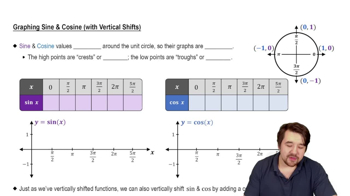
Graph of Sine and Cosine Function