Ch. 1 - Functions
Hass - Thomas' Calculus 15th Edition
Hass15th EditionThomas' CalculusISBN: 9780137616077당신이 사용하는 게 아니라요?교과서 변경
1장, 문제 27a

[Technology Exercise]


a. Graph y = cos x and y = sec x together for −3π/2 ≤ x ≤ 3π/2. Comment on the behavior of sec x in relation to the signs and values of cos x.

검증된 단계별 안내
1
Start by understanding the relationship between the functions y = cos(x) and y = sec(x). Recall that sec(x) is the reciprocal of cos(x), meaning sec(x) = 1/cos(x). This implies that sec(x) is undefined wherever cos(x) is zero.
Graph y = cos(x) over the interval −3π/2 ≤ x ≤ 3π/2. The cosine function is periodic with a period of 2π, and it oscillates between -1 and 1. Identify the key points where cos(x) equals 0, which are at x = -π/2, x = π/2, and x = 3π/2 within the given interval.
Graph y = sec(x) over the same interval. Since sec(x) = 1/cos(x), wherever cos(x) is zero, sec(x) will have vertical asymptotes. These occur at x = -π/2, x = π/2, and x = 3π/2. Between these points, sec(x) will take on positive values when cos(x) is positive and negative values when cos(x) is negative.
Observe the behavior of sec(x) in relation to cos(x). When cos(x) is positive, sec(x) will also be positive and greater than or equal to 1. When cos(x) is negative, sec(x) will be negative and less than or equal to -1. The magnitude of sec(x) increases as the value of cos(x) approaches zero from either side.
Comment on the graph: Notice that sec(x) has vertical asymptotes at the points where cos(x) crosses zero. Between these asymptotes, sec(x) mirrors the sign of cos(x) but with larger magnitude, especially as cos(x) approaches zero. This behavior highlights the reciprocal nature of sec(x) relative to cos(x).

비슷한 문제에 대한 검증된 영상 답변:

이 영상 해법은 위 문제에 도움이 된다고 튜터들이 추천한 것입니다.
영상 길이:
11m
도움이 되었나요?

주요 개념

질문에 올바르게 답하기 위해 반드시 이해해야 하는 핵심 개념들은 다음과 같습니다.

Cosine Function

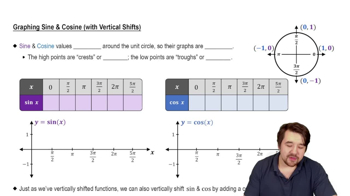
The cosine function, denoted as cos(x), is a periodic function that represents the x-coordinate of a point on the unit circle corresponding to an angle x. It oscillates between -1 and 1, with a period of 2π. Understanding its graph is crucial for analyzing the behavior of related functions, such as secant.
추천 영상:
5:53
Graph of Sine and Cosine Function

Secant Function

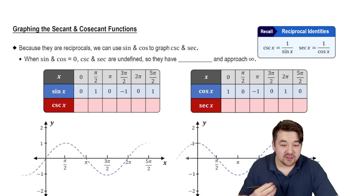
The secant function, denoted as sec(x), is the reciprocal of the cosine function, defined as sec(x) = 1/cos(x). It is undefined wherever cos(x) equals zero, leading to vertical asymptotes in its graph. The behavior of sec(x) is directly influenced by the values of cos(x), particularly its signs.
추천 영상:
6:22
Graphs of Secant and Cosecant Functions

Graphing Trigonometric Functions

Graphing trigonometric functions involves plotting their values over a specified interval, which helps visualize their periodic nature and relationships. When graphing y = cos(x) and y = sec(x) together, one can observe how sec(x) behaves in relation to cos(x), particularly noting where sec(x) approaches infinity as cos(x) approaches zero.
추천 영상:
6:04
Introduction to Trigonometric Functions