Ch. 10 - Infinite Sequences and Series
Hass - Thomas' Calculus 15th Edition
Hass15th EditionThomas' CalculusISBN: 9780137616077당신이 사용하는 게 아니라요?교과서 변경
10장, 문제 10.2.48

Find the sum of each series in Exercises 45–52.
∑ (from n = 1 to ∞) [ (2n + 1) / (n²(n + 1)²) ]

검증된 단계별 안내
1
Start by examining the general term of the series: \(\frac{2n + 1}{n^{2}(n + 1)^{2}}\). Our goal is to express this term in a form that allows us to use telescoping or known series sums.
Try to decompose the term into partial fractions. Since the denominator is \(n^{2}(n + 1)^{2}\), consider expressing the term as a sum of fractions of the form \(\frac{A}{n} + \frac{B}{n^{2}} + \frac{C}{n + 1} + \frac{D}{(n + 1)^{2}}\).
Set up the equation: \(\frac{2n + 1}{n^{2}(n + 1)^{2}} = \frac{A}{n} + \frac{B}{n^{2}} + \frac{C}{n + 1} + \frac{D}{(n + 1)^{2}}\). Multiply both sides by \(n^{2}(n + 1)^{2}\) to clear denominators and solve for constants \(A\), \(B\), \(C\), and \(D\) by equating coefficients of powers of \(n\).
Once the partial fractions are found, rewrite the series as a sum of simpler series: \(\sum_{n=1}^{\infty} \left( \frac{A}{n} + \frac{B}{n^{2}} + \frac{C}{n + 1} + \frac{D}{(n + 1)^{2}} \right)\). This will allow you to separate the original series into sums that are easier to evaluate or telescope.
Evaluate the sums by recognizing telescoping patterns or using known series results such as the Riemann zeta function for \(\sum \frac{1}{n^{2}}\). Combine the results carefully to find the sum of the original series.

비슷한 문제에 대한 검증된 영상 답변:

이 영상 해법은 위 문제에 도움이 된다고 튜터들이 추천한 것입니다.
영상 길이:
13m

주요 개념

질문에 올바르게 답하기 위해 반드시 이해해야 하는 핵심 개념들은 다음과 같습니다.

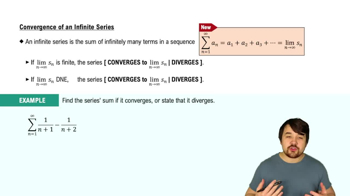
Infinite Series and Convergence

An infinite series is the sum of infinitely many terms. To find its sum, the series must converge, meaning its partial sums approach a finite limit. Understanding convergence tests helps determine if the series sum exists.
추천 영상:
가이드 코스
06:52
Convergence of an Infinite Series

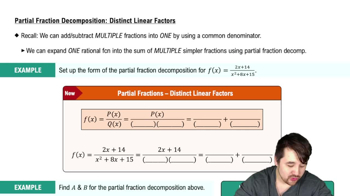
Partial Fraction Decomposition

Partial fraction decomposition breaks a complex rational expression into simpler fractions. This technique simplifies terms in the series, making it easier to identify telescoping patterns or to sum the series explicitly.
추천 영상:
가이드 코스
10:07
Partial Fraction Decomposition: Distinct Linear Factors

Telescoping Series

A telescoping series is one where many terms cancel out when the series is expanded. Recognizing this pattern allows simplification of the sum to just a few terms, facilitating the calculation of the infinite sum.
추천 영상:
가이드 코스
06:00
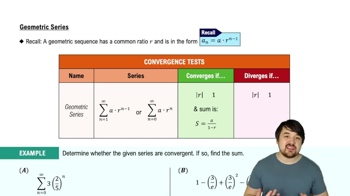
Geometric Series