Ch. 10 - Infinite Sequences and Series
Hass - Thomas' Calculus 15th Edition
Hass15th EditionThomas' CalculusISBN: 9780137616077당신이 사용하는 게 아니라요?교과서 변경
10장, 문제 10.8.25

Finding Taylor and Maclaurin Series
In Exercises 25–34, find the Taylor series generated by f at x = a.
f(x) = x³ − 2x + 4,a = 2

검증된 단계별 안내
1
Identify the function and the point about which the Taylor series is generated: here, the function is \(f(x) = x^{3} - 2x + 4\) and the center is \(a = 2\).
Recall the formula for the Taylor series of a function \(f\) about \(x = a\): \[f(x) = \sum_{n=0}^{\infty} \frac{f^{(n)}(a)}{n!} (x - a)^{n}\] where \(f^{(n)}(a)\) is the \(n\)-th derivative of \(f\) evaluated at \(x = a\).
Compute the derivatives of \(f(x)\) up to the order needed (usually until the derivatives become zero or a pattern emerges): - \(f(x) = x^{3} - 2x + 4\) - \(f'(x) = 3x^{2} - 2\) - \(f''(x) = 6x\) - \(f^{(3)}(x) = 6\) - \(f^{(4)}(x) = 0\) (and all higher derivatives are zero).
Evaluate each derivative at \(x = 2\): - \(f(2) = 2^{3} - 2(2) + 4\) - \(f'(2) = 3(2)^{2} - 2\) - \(f''(2) = 6(2)\) - \(f^{(3)}(2) = 6\) - \(f^{(4)}(2) = 0\).
Write the Taylor series expansion using the formula and the evaluated derivatives: \[f(x) = f(2) + \frac{f'(2)}{1!}(x - 2) + \frac{f''(2)}{2!}(x - 2)^{2} + \frac{f^{(3)}(2)}{3!}(x - 2)^{3} + \cdots\] Since higher derivatives are zero, the series will terminate here.

비슷한 문제에 대한 검증된 영상 답변:

이 영상 해법은 위 문제에 도움이 된다고 튜터들이 추천한 것입니다.
영상 길이:
4m
도움이 되었나요?

주요 개념

질문에 올바르게 답하기 위해 반드시 이해해야 하는 핵심 개념들은 다음과 같습니다.

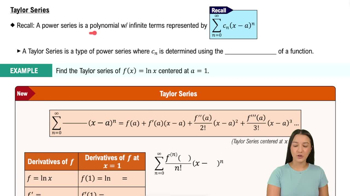
Taylor Series

A Taylor series represents a function as an infinite sum of terms calculated from the derivatives of the function at a single point a. It approximates the function near that point using polynomial terms, where each term involves the nth derivative evaluated at a, multiplied by (x - a)^n and divided by n!.
추천 영상:
08:42
Taylor Series

Maclaurin Series

The Maclaurin series is a special case of the Taylor series centered at a = 0. It expresses a function as an infinite sum of derivatives evaluated at zero, useful for approximating functions near zero. Understanding this helps distinguish between general Taylor expansions and those specifically at zero.
추천 영상:
08:26
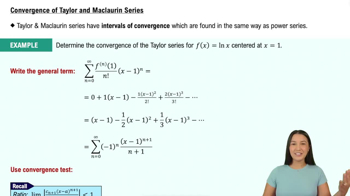
Convergence of Taylor & Maclaurin Series

Derivatives and Their Role in Series Expansion

Derivatives of a function at the point a determine the coefficients of the Taylor series. Calculating successive derivatives and evaluating them at a provides the necessary values to build each term of the series, reflecting the function's behavior near a.
추천 영상:
가이드 코스
06:00
Geometric Series