
교과서 질문
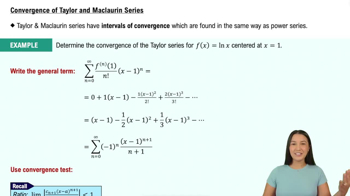
Finding Taylor and Maclaurin Series
In Exercises 25–34, find the Taylor series generated by f at x = a.
f(x) = cos(2x + π/2),a = π/4
28
views

 검증된 단계별 안내
 08:26
08:26
 06:45
06:45 6:04
6:04Finding Taylor and Maclaurin Series
In Exercises 25–34, find the Taylor series generated by f at x = a.
f(x) = cos(2x + π/2),a = π/4
Determining Convergence or Divergence
Which of the series in Exercises 17–56 converge, and which diverge? Use any method, and give reasons for your answers.
∑ (from n=1 to ∞) (1 − n) / n2ⁿ
Intervals of Convergence
In Exercises 1–36, (a) find the series’ radius and interval of convergence. For what values of x does the series converge (b) absolutely, (c) conditionally?
∑ (from n = 1 to ∞) [ (x − 1)ⁿ / (n³ 3ⁿ) ]
In Exercises 37–42, find the series’ radius of convergence.
∑ (from n = 1 to ∞) [ n! xⁿ / nⁿ ]
Applying the Integral Test
Use the Integral Test to determine if the series in Exercises 1–12 converge or diverge. Be sure to check that the conditions of the Integral Test are satisfied.
∑ (from n = 1 to ∞) 1 / n⁰·²
Intervals of Convergence
In Exercises 1–36, (a) find the series’ radius and interval of convergence. For what values of x does the series converge (b) absolutely, (c) conditionally?
∑ (from n = 0 to ∞) [ n xⁿ / (4ⁿ (n² + 1)) ]