
Ch. 11 - Parametric Equations and Polar Coordinates
Hass - Thomas' Calculus 15th Edition
Hass15th EditionThomas' CalculusISBN: 9780137616077당신이 사용하는 게 아니라요?교과서 변경
11장, 문제 11.3.66

Cartesian to Polar Equations


Replace the Cartesian equations in Exercises 53–66 with equivalent polar equations.
(x + 2)² + (y − 5)² = 16"

검증된 단계별 안내
1
Recall the relationships between Cartesian coordinates \((x, y)\) and polar coordinates \((r, \theta)\): \(x = r \cos{\theta}\) and \(y = r \sin{\theta}\).
Substitute \(x = r \cos{\theta}\) and \(y = r \sin{\theta}\) into the given equation \((x + 2)^2 + (y - 5)^2 = 16\) to rewrite it in terms of \(r\) and \(\theta\).
Expand the terms inside the parentheses: \((r \cos{\theta} + 2)^2 + (r \sin{\theta} - 5)^2 = 16\).
Use algebraic expansion to write the equation as \(r^2 \cos^2{\theta} + 4r \cos{\theta} + 4 + r^2 \sin^2{\theta} - 10r \sin{\theta} + 25 = 16\).
Combine like terms and use the Pythagorean identity \(\cos^2{\theta} + \sin^2{\theta} = 1\) to simplify the equation to a form involving \(r\) and \(\theta\) only.

비슷한 문제에 대한 검증된 영상 답변:

이 영상 해법은 위 문제에 도움이 된다고 튜터들이 추천한 것입니다.
영상 길이:
2m
도움이 되었나요?

주요 개념

질문에 올바르게 답하기 위해 반드시 이해해야 하는 핵심 개념들은 다음과 같습니다.

Cartesian and Polar Coordinate Systems

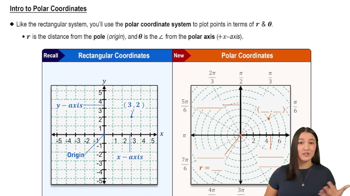
Cartesian coordinates represent points using (x, y) values on perpendicular axes, while polar coordinates use (r, θ), where r is the distance from the origin and θ is the angle from the positive x-axis. Understanding how these systems describe points differently is essential for converting equations between them.
추천 영상:
05:32
Intro to Polar Coordinates

Conversion Formulas Between Cartesian and Polar Coordinates

The key formulas for conversion are x = r cos(θ) and y = r sin(θ). These allow substitution of x and y in Cartesian equations with expressions in terms of r and θ, enabling the rewriting of Cartesian equations into polar form.
추천 영상:
05:32
Intro to Polar Coordinates

Equation of a Circle in Cartesian and Polar Forms

A circle centered at (h, k) with radius r satisfies (x - h)² + (y - k)² = r² in Cartesian form. To express this in polar coordinates, substitute x and y with r cos(θ) and r sin(θ), then simplify to find an equation involving r and θ.
추천 영상:
6:50
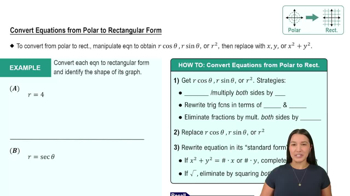
Convert Equations from Polar to Rectangular
관련 실천
교과서 질문

Ellipses and Eccentricity


Exercises 9–12 give the foci or vertices and the eccentricities of ellipses centered at the origin of the xy-plane. In each case, find the ellipse’s standard-form equation in Cartesian coordinates.


Vertices: (±10,0)

Eccentricity: 0.24

6
views
교과서 질문

Surface Area


Find the areas of the surfaces generated by revolving the curves in Exercises 31-34 about the indicated axes.


x = t + √2, y = (t²/2) + √2t, −√2 ≤ t ≤ √2; y−axis

24
views
교과서 질문

Finding Polar Areas


Find the areas of the regions in Exercises 9–18.


Shared by the circles r = 1 and r = 2 sin θ

21
views
교과서 질문

Finding Cartesian from Parametric Equations


Exercises 1–18 give parametric equations and parameter intervals for the motion of a particle in the xy-plane. Identify the particle’s path by finding a Cartesian equation for it. Graph the Cartesian equation. (The graphs will vary with the equation used.) Indicate the portion of the graph traced by the particle and the direction of motion.


x=√(t+1), y=√t, t ≥ 0

35
views
교과서 질문

Hyperbolas and Eccentricity


In Exercises 17-24, find the eccentricity of the hyperbola. Then find and graph the hyperbola's foci and directrices.


y² − x² = 4

37
views
교과서 질문

Hyperbolas and Eccentricity


Exercises 25–28 give the eccentricities and the vertices or foci of hyperbolas centered at the origin of the xy-plane. In each case, find the hyperbola’s standard-form equation in Cartesian coordinates.


Eccentricity: 1.25

Foci: (0, ±5)

6
views