Ch. 11 - Parametric Equations and Polar Coordinates
Hass - Thomas' Calculus 15th Edition
Hass15th EditionThomas' CalculusISBN: 9780137616077당신이 사용하는 게 아니라요?교과서 변경
11장, 문제 11.6.25

Ellipses


Exercises 25 and 26 give information about the foci and vertices of ellipses centered at the origin of the xy−plane. In each case, find the ellipse's standard−form equation from the given information.


Foci: ( ±√2, 0) Vertices: (±2,0)

검증된 단계별 안내
1
Identify the orientation of the ellipse based on the given points. Since the foci and vertices lie on the x-axis (points have the form (±x, 0)), the major axis is horizontal.
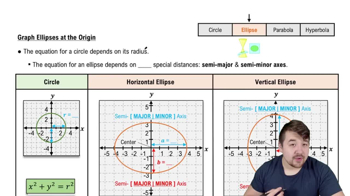
Recall the standard form of the ellipse equation centered at the origin with a horizontal major axis: \(\frac{x^{2}}{a^{2}} + \frac{y^{2}}{b^{2}} = 1\), where \(a\) is the semi-major axis length and \(b\) is the semi-minor axis length.
Determine \(a\) from the vertices. The vertices are at \((\pm 2, 0)\), so \(a = 2\) and therefore \(a^{2} = 4\).
Determine \(c\) from the foci. The foci are at \((\pm \sqrt{2}, 0)\), so \(c = \sqrt{2}\) and therefore \(c^{2} = 2\).
Use the relationship between \(a\), \(b\), and \(c\) for ellipses: \(c^{2} = a^{2} - b^{2}\). Substitute the known values to solve for \(b^{2}\), then write the standard form equation \(\frac{x^{2}}{a^{2}} + \frac{y^{2}}{b^{2}} = 1\).

비슷한 문제에 대한 검증된 영상 답변:

이 영상 해법은 위 문제에 도움이 된다고 튜터들이 추천한 것입니다.
영상 길이:
2m
도움이 되었나요?

주요 개념

질문에 올바르게 답하기 위해 반드시 이해해야 하는 핵심 개념들은 다음과 같습니다.

Standard Form of an Ellipse Centered at the Origin

An ellipse centered at the origin has the equation \( \frac{x^2}{a^2} + \frac{y^2}{b^2} = 1 \) if the major axis is along the x-axis, where \(a\) is the semi-major axis length and \(b\) is the semi-minor axis length. Knowing the vertices and foci helps determine \(a\), \(b\), and \(c\) (distance from center to foci).
추천 영상:
가이드 코스
5:12
Graph Ellipses at Origin

Relationship Between Vertices, Foci, and Axes Lengths

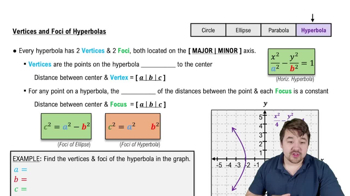
For an ellipse, the distance from the center to each vertex is \(a\), and the distance to each focus is \(c\). These satisfy the equation \(c^2 = a^2 - b^2\). Given vertices and foci, you can find \(a\), \(c\), and then calculate \(b\) to write the ellipse equation.
추천 영상:
가이드 코스
5:22
Foci and Vertices of Hyperbolas

Identifying the Orientation of the Ellipse

The orientation of the ellipse (horizontal or vertical major axis) is determined by the coordinates of the vertices and foci. Since both vertices and foci lie on the x-axis (\(y=0\)), the major axis is horizontal, so \(x^2\) is over \(a^2\) in the standard form.
추천 영상:
가이드 코스
4:50
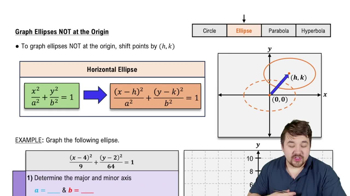
Graph Ellipses NOT at Origin
관련 실천
교과서 질문

Shifting Conic Sections


Find the center, foci, vertices, asymptotes, and radius, as appropriate, of the conic sections in Exercises 57-68.


9x² + 6y² + 36y = 0

24
views

교과서 질문

Finding Cartesian from Parametric Equations


Exercises 1–18 give parametric equations and parameter intervals for the motion of a particle in the xy-plane. Identify the particle’s path by finding a Cartesian equation for it. Graph the Cartesian equation. (The graphs will vary with the equation used.) Indicate the portion of the graph traced by the particle and the direction of motion.


x = 2 sinh t, y = 2 cosh t, −∞<t<∞

28
views
교과서 질문

Circles


Sketch the circles in Exercises 53–56. Give polar coordinates for their centers and identify their radii.


r = −2 cos θ

23
views
교과서 질문

Parabolas


Exercises 9-16 give equations of parabolas. Find each parabola's focus and directrix. Then sketch the parabola. Include the focus and directrix in your sketch.


x = −3y²

37
views
교과서 질문

Parabolas


Exercises 9-16 give equations of parabolas. Find each parabola's focus and directrix. Then sketch the parabola. Include the focus and directrix in your sketch.


x² = 6y

27
views
교과서 질문

Shifting Conic Sections


You may wish to review Section 1.2 before solving Exercises 39-56.


Exercises 53-56 give equations for hyperbolas and tell how many units up or down and to the right or left each hyperbola is to be shifted. Find an equation for the new hyperbola, and find the new center, foci, vertices, and asymptotes.


x²/4 − y²/5 = 1, right 2, up 2

26
views