Ch. 2 - Limits and Continuity
Hass - Thomas' Calculus 15th Edition
Hass15th EditionThomas' CalculusISBN: 9780137616077당신이 사용하는 게 아니라요?교과서 변경
2장, 문제 2.4.4c

Finding Limits Graphically


Let f(x) = {3 - x , x < 2
2, x = 2
x/2, x > 2


<IMAGE>


c. Find limx→−1− f(x) and limx→−1+ f(x).

검증된 단계별 안내
1
Identify the piecewise function f(x) and the conditions for each piece. Here, f(x) = 3 - x for x < 2 and f(x) = x/2 for x > 2.
Understand that the limit as x approaches -1 from the left, denoted as lim_{x→−1−} f(x), involves considering values of x that are slightly less than -1.
Since -1 is less than 2, use the piece of the function f(x) = 3 - x to evaluate the left-hand limit. Substitute x = -1 into this expression to find the limit.
For the limit as x approaches -1 from the right, denoted as lim_{x→−1+} f(x), consider values of x that are slightly greater than -1.
Again, since -1 is less than 2, use the same piece of the function f(x) = 3 - x to evaluate the right-hand limit. Substitute x = -1 into this expression to find the limit.

비슷한 문제에 대한 검증된 영상 답변:

이 영상 해법은 위 문제에 도움이 된다고 튜터들이 추천한 것입니다.
영상 길이:
4m
도움이 되었나요?

주요 개념

질문에 올바르게 답하기 위해 반드시 이해해야 하는 핵심 개념들은 다음과 같습니다.

Limits

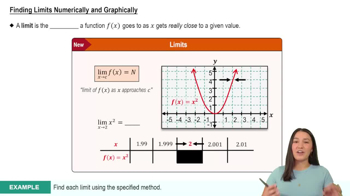
A limit is a fundamental concept in calculus that describes the behavior of a function as its input approaches a certain value. It helps in understanding how functions behave near points of interest, including points of discontinuity. Limits can be approached from the left (denoted as lim x→c−) or from the right (denoted as lim x→c+), which is crucial for analyzing piecewise functions.
추천 영상:
05:50
One-Sided Limits

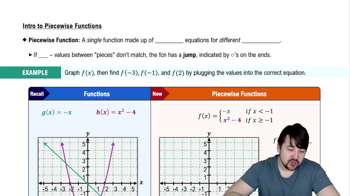
Piecewise Functions

A piecewise function is defined by different expressions based on the input value. In the given function f(x), different formulas apply for x values less than, equal to, or greater than 2. Understanding how to evaluate piecewise functions is essential for finding limits, especially when the limit point lies at a boundary between pieces.
추천 영상:
05:36
Piecewise Functions

Graphical Interpretation of Limits

Graphically interpreting limits involves analyzing the behavior of a function's graph as it approaches a specific x-value. This includes observing the values the function approaches from both the left and right sides. For the question at hand, examining the graph of f(x) will help determine the left-hand limit (lim x→−1− f(x)) and the right-hand limit (lim x→−1+ f(x)).
추천 영상:
6:47
Finding Limits Numerically and Graphically